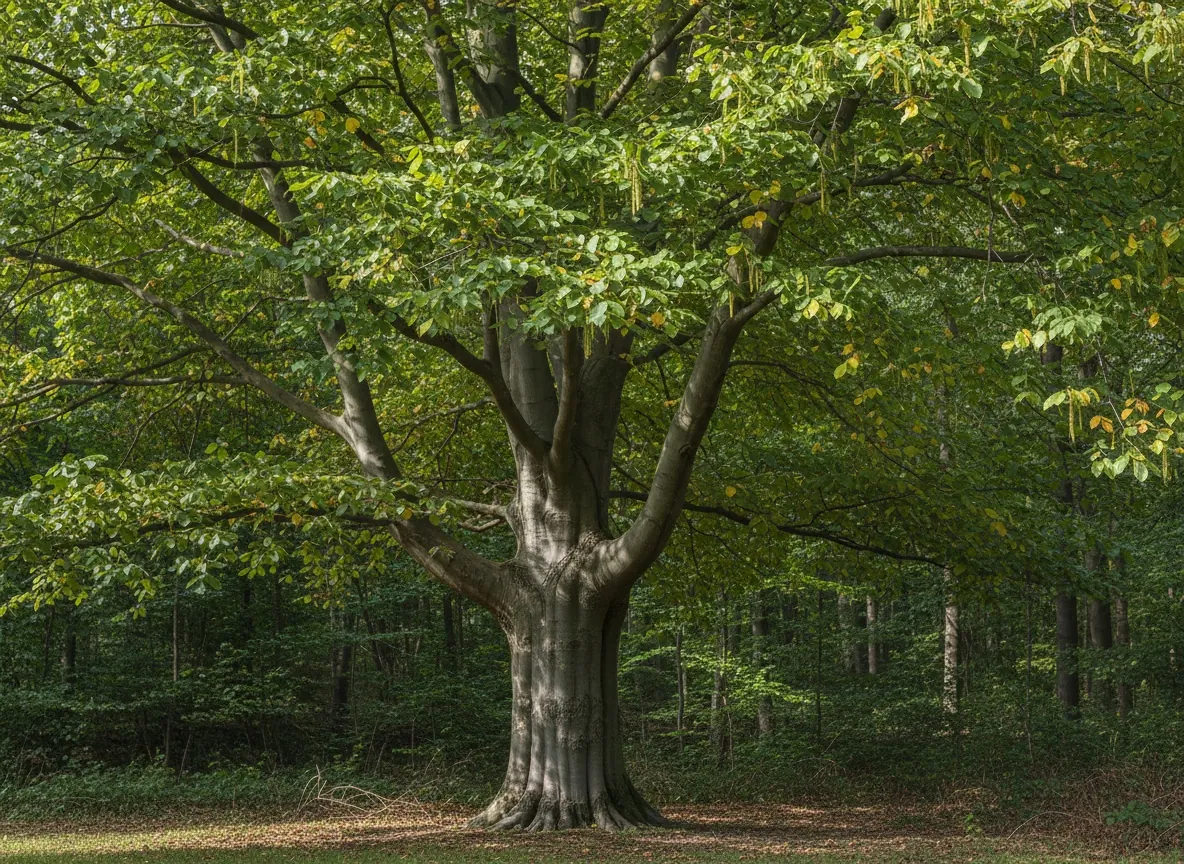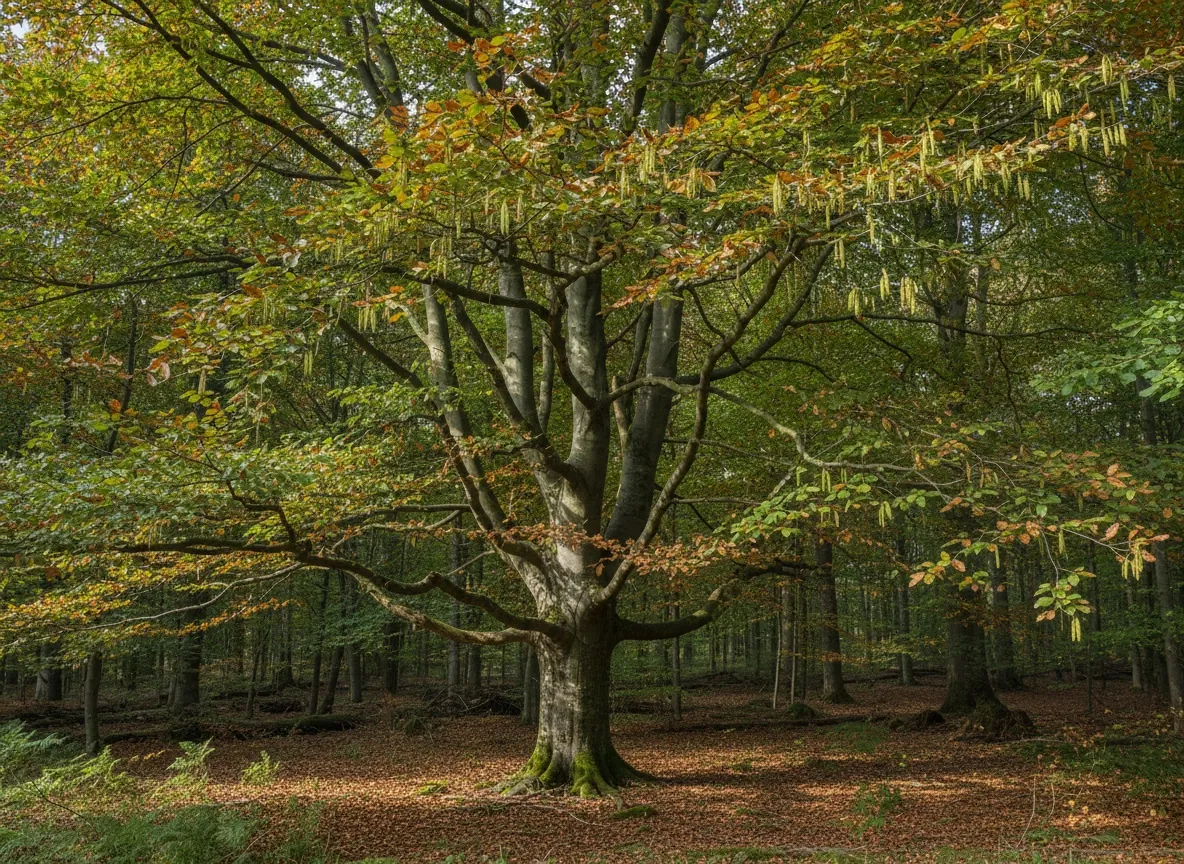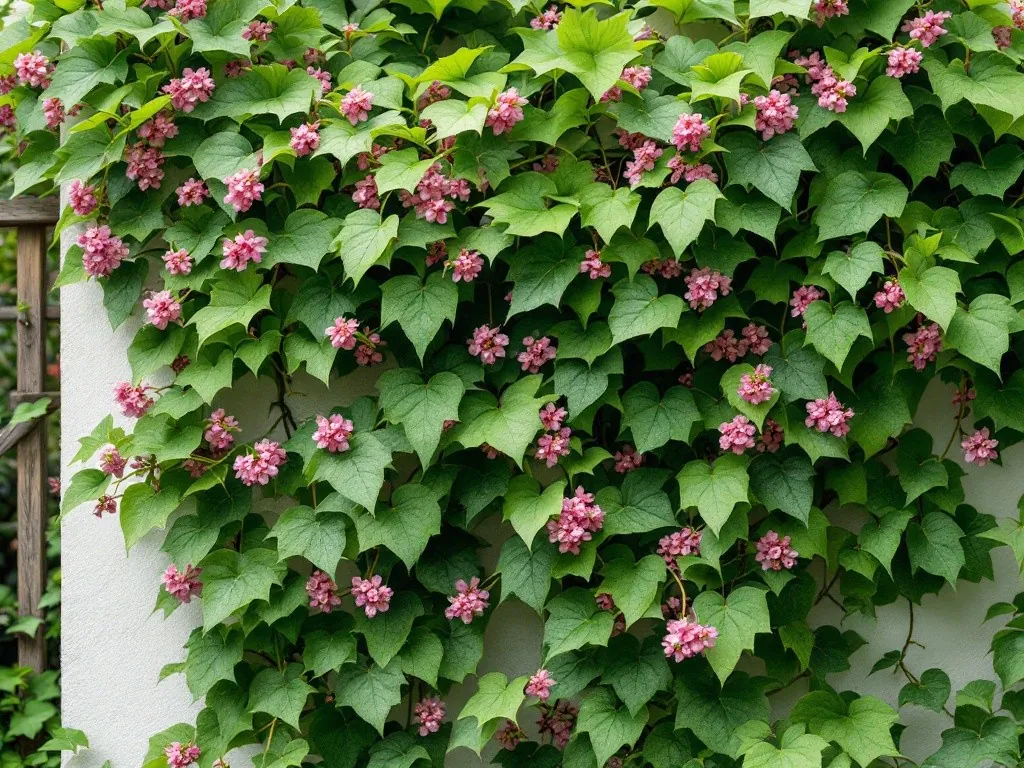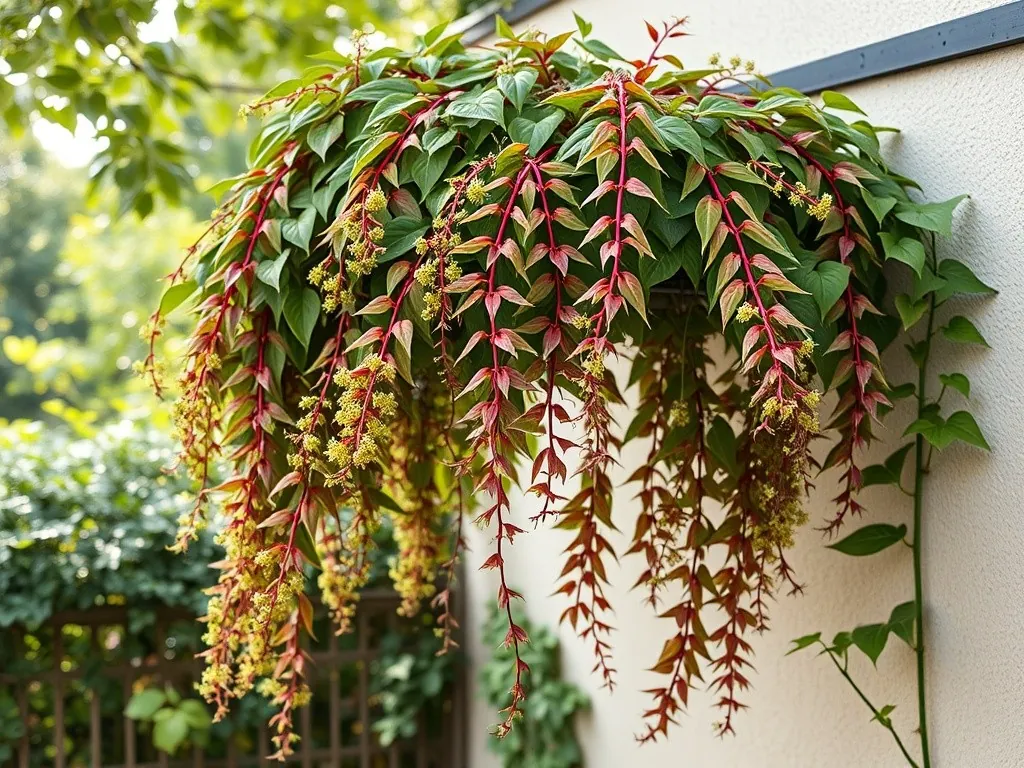
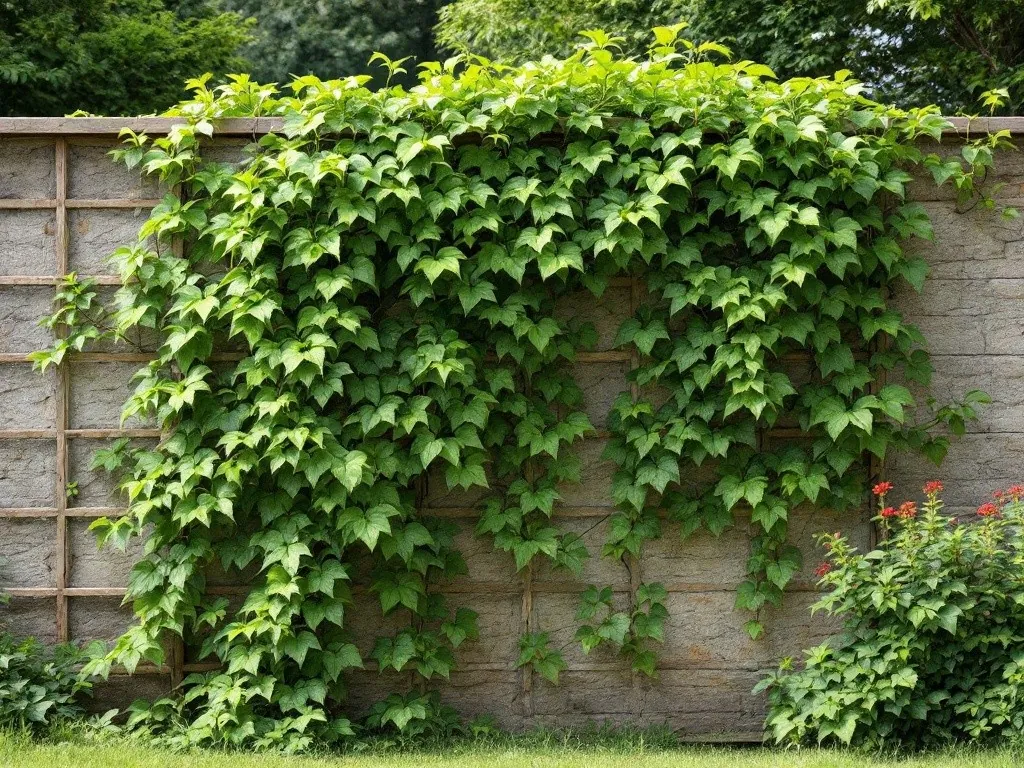
In short
- It attaches itself to walls, bark and rocks using aerial rootlets – it needs no trellis or wires.
- Unlike most climbers, it grows well in shade and partial shade, not only in full sun.
- It flowers late, in September–October, when few other plants provide nectar for bees.
- The black berries that ripen in winter are an important food source for birds.
- The whole plant is toxic to humans and pets if eaten.
- Very frost-hardy (zone 4a–9b) and can live for many decades.
Botanical data
- Family
- Araliaceae (Araliaceae)
- Height
- 3–20 m
- Width
- 1–5 m
- Habit
- Creeping
- Growth rate
- Moderate
- Position
- Shade, Partial shade, Full sun
- Soil
- Loamy, Humus-rich, Chalky
- pH reaction
- pH 6–7.8
- Moisture
- Moderate, Moist
- Bloom
- September–October
- Hardiness
- USDA 4a–9b
- Propagation
- From cuttings, By layering
Characteristics
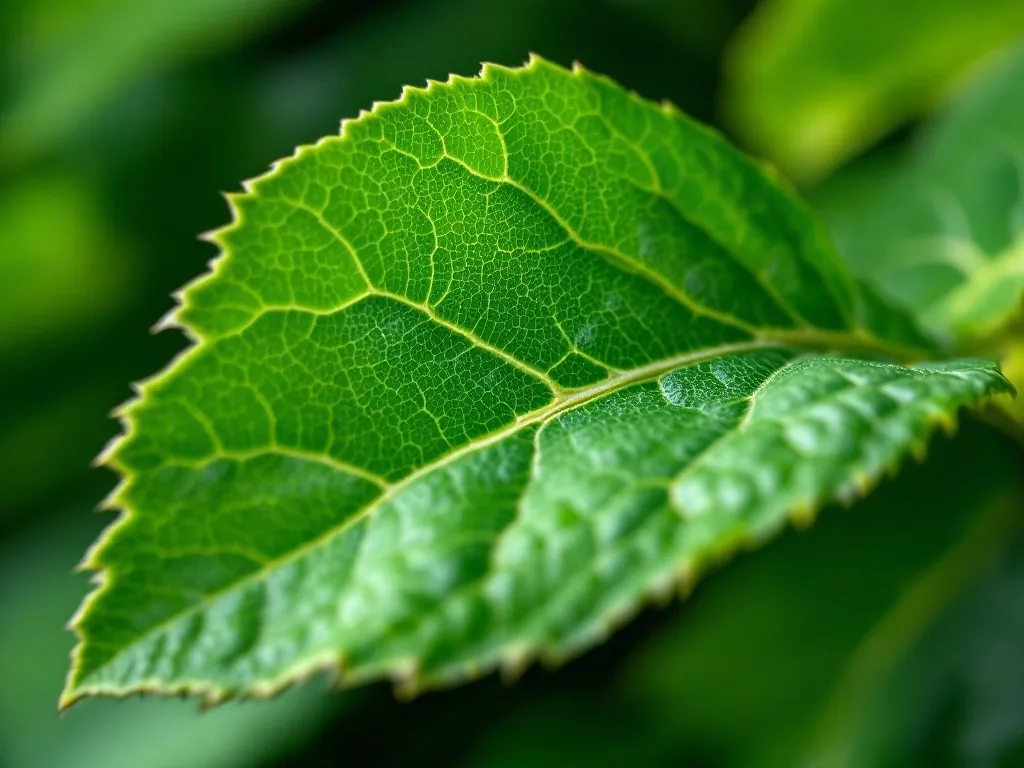
An evergreen, woody climber with two growth forms: the juvenile, creeping or climbing shoots bear characteristic lobed leaves with 3–5 lobes, while the mature shoots, which flower on sunny, high sections, have entire, ovate leaves. The flowers are small, greenish, arranged in spherical umbels, inconspicuous but rich in nectar. The fruit is a black, spherical berry.
Growing and care
Watering
Once established, very drought-tolerant; watering is needed mainly in the first year after planting and during prolonged heatwaves.
Fertilizing
An undemanding plant – on poor, infertile soils a small dose of multi-nutrient fertiliser may be added.
Planting
It tolerates almost any garden soil; it attaches itself using aerial rootlets to walls, tree bark and other rough surfaces – it needs no mesh, wires or other support.
Pruning
Cut back shoots extending beyond the designated area and remove growth blocking gutters, windows and roof tiles.
Companion plants
Good companions
Ivy attaches itself using aerial rootlets to rough surfaces such as brick or bark and requires no additional fixing.
Bad companions
Dense ivy growth on a young tree can restrict light reaching its crown and make it harder to monitor the health of the trunk.
The evidence level indicates whether the relationship is backed by research, observation, or gardening tradition.
Diseases and pests
Small (1–3 mm) soft-bodied insects, green, black or pink, feeding in clusters on young shoots and the underside of leaves. They excrete sticky honeydew.
Spider mitesTiny (0.3–0.5 mm) arachnids, hard to spot with the naked eye, feeding on the underside of leaves. Symptoms: fine, pale speckling (feeding punctures); over time the leaves turn grey, yellow and dry out. Under heavy infestation a fine webbing becomes visible. Warm, dry air favours their development — a common problem for houseplants in winter near radiators.
Armoured and soft scale insectsImmobile, brown or yellowish shields (1–4 mm) attached to stems and the underside of leaves, especially along the veins. Easily mistaken for growths on the plant. They suck sap, causing yellowing and weakening, and excrete sticky honeydew. Common on figs, orchids and plants with tough leaves.
Toxicity
| For whom | Level | Notes |
|---|---|---|
| Humans | Moderate | The leaves and fruit (black berries) contain saponins – ingestion causes nausea, vomiting and abdominal pain, and contact with the sap can cause skin irritation. |
| Dogs | Moderate | — |
| Cats | Moderate | — |
History and origin
Ivy has been a native component of European deciduous forests for millennia and has held strong symbolic significance since antiquity – in Greek and Roman mythology the ivy wreath was associated with the cult of Dionysus/Bacchus as a symbol of fidelity and eternal endurance (evergreen leaves). In ornamental horticulture it has been cultivated for centuries as a ground cover and for clothing walls.
Uses
For clothing walls, fences and the trunks of old trees, as a dense, evergreen ground cover in shady corners of the garden where few other plants take hold, and as a plant of high value to pollinators and birds in wildlife-friendly gardens.
Trivia
- Ivy only flowers on mature, older shoots that have already climbed for several years and reached sufficient light – young, creeping shoots at ground level never flower.
- Its late-autumn flowering (September–October) makes ivy one of the last available nectar sources for bees and other pollinators before winter, when most plants have already finished blooming.
- Ivy's black berries, toxic to humans, are a safe and valued food for fieldfares, black redstarts and other birds overwintering in Poland.
Frequently asked questions
Does ivy damage walls and building facades?
On solid, intact walls ivy usually causes no significant damage and even protects the render from moisture and temperature fluctuations. The problem lies with walls that are already cracked or of weak structure – there the aerial rootlets can penetrate the crevices. Regular pruning around gutters, windows and roof tiles prevents problems.
Does ivy need sun to grow well?
No, it is one of the few climbers that copes well in shade and deep partial shade – in the wild it grows as the understorey of deciduous forests. In sun it grows a little faster and flowers more readily, but shade is no obstacle for it.
Why does my ivy never flower?
Flowers appear only on mature shoots that have already climbed for several years and reached the well-lit, higher sections of their support. Shoots creeping along the ground or recently planted specimens remain in the juvenile phase and do not flower.
Sources
- Plants of the World Online (POWO)Database (GBIF, POWO…)
- RHS — Hedera helixInstitution / botanical garden
My note
A private note for this plant — saved in your browser.