In short
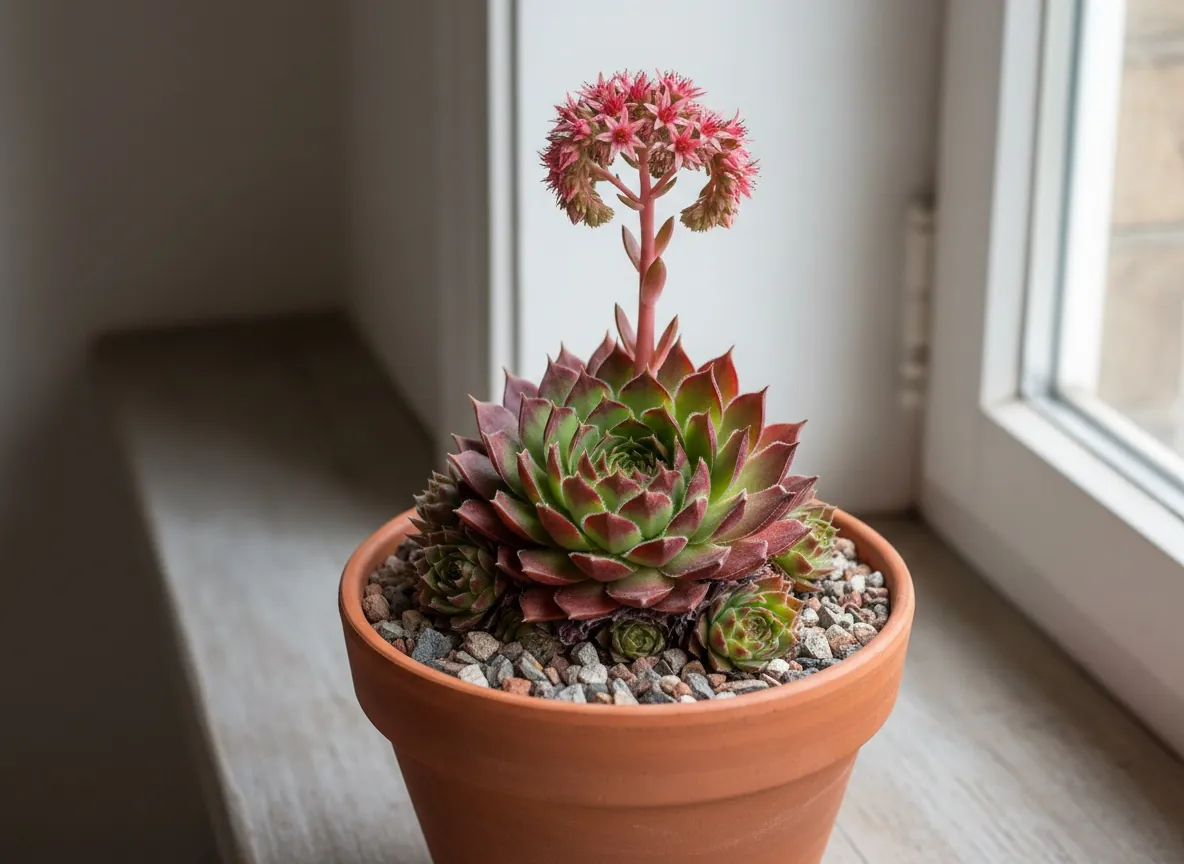
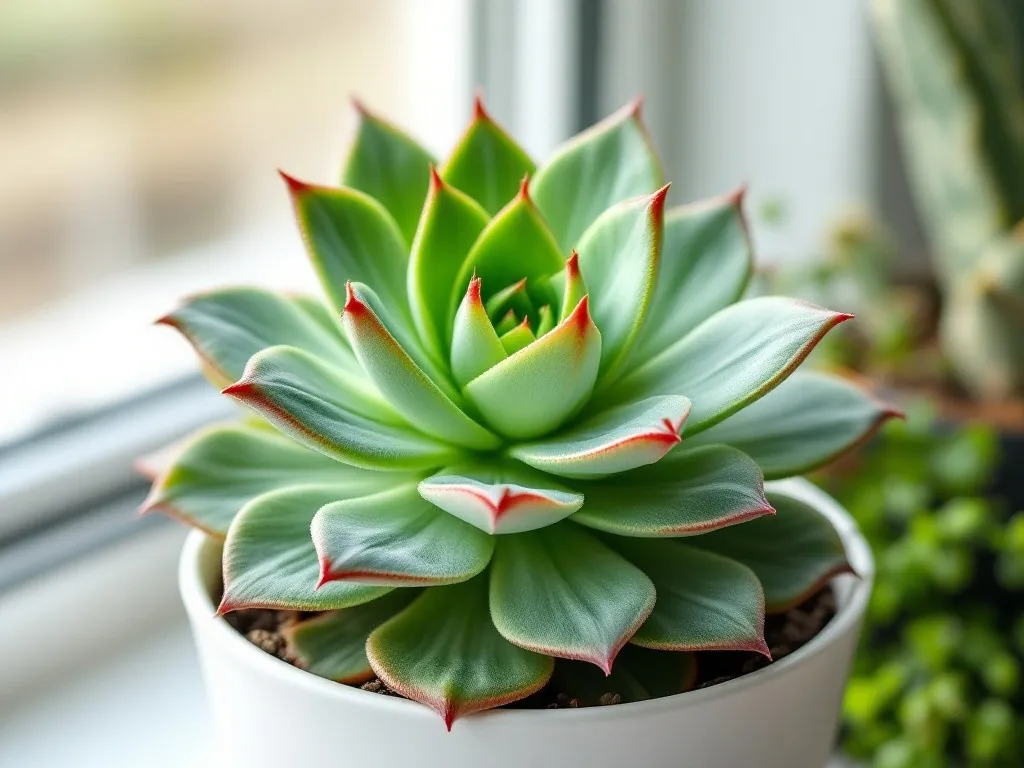
- Forms a small (5-15 cm), very regular rosette of blue-green, fleshy leaves coated with a waxy bloom.
- In spring it sends up an arching stem bearing pink-and-yellow, bell-shaped flowers.
- Requires full sun or a very bright position and extremely infrequent watering.
- Not frost-hardy - in Poland it overwinters indoors only, as a houseplant.
- Propagates easily from single leaves, in time forming offset rosettes around the mother plant.
- The most common cultivation mistake is overwatering, which leads to rotting of the roots and rosette.
Botanical data
- Family
- Crassulaceae (Crassulaceae)
- Height
- 0.05–0.15 m
- Width
- 0.1–0.2 m
- Habit
- Clump-forming
- Growth rate
- Slow
- Position
- Full sun, Partial shade
- Soil
- Sandy
- pH reaction
- pH 6–7.5
- Moisture
- Dry
- Bloom
- March–May
- Hardiness
- USDA 9b–11b
- Propagation
- From cuttings, By division
Characteristics
A stemless succulent, or one with a very short stem, forming a tight, symmetrical rosette of spoon-shaped, fleshy leaves in a blue-green to grey-blue shade, covered with a delicate waxy bloom (pruinose coating). In spring a tall, arching flower stem grows from the centre of the rosette, bearing small, pink-and-yellow, bell-shaped flowers.
Growing and care
Watering
Water only once the substrate has dried out completely, using the immersion method or from below, avoiding flooding the rosette - water collecting between the leaves can cause them to rot.
Fertilizing
Very undemanding - excess nitrogen elongates and stretches the rosette, robbing it of its compact, ornamental form.
Planting
A well-draining mineral substrate for cacti and succulents with added sand or perlite; a pot with a drainage hole.
Pruning
Remove drying lower leaves of the rosette as well as elongated, blanched shoots caused by a lack of light.
Companion plants
Good companions
Identical requirements - full sun, a well-draining mineral substrate and infrequent watering; together they make striking arrangements in shallow bowls.
Bad companions
A shared substrate kept constantly moist leads to rotting of the roots and rosette of the echeveria, which is accustomed to dry, stony sites.
The evidence level indicates whether the relationship is backed by research, observation, or gardening tradition.
Diseases and pests
Insects covered in a white, cottony, waxy coating, gathering in leaf axils, at the base of shoots and on the underside of leaf blades. They look like tufts of cotton wool. They suck sap, weaken the plant and excrete sticky honeydew, on which black sooty mould develops. A common pest of houseplants and succulents.
Spider mitesTiny (0.3–0.5 mm) arachnids, hard to spot with the naked eye, feeding on the underside of leaves. Symptoms: fine, pale speckling (feeding punctures); over time the leaves turn grey, yellow and dry out. Under heavy infestation a fine webbing becomes visible. Warm, dry air favours their development — a common problem for houseplants in winter near radiators.
Toxicity
| For whom | Level | Notes |
|---|---|---|
| Humans | None | — |
| Dogs | None | — |
| Cats | None | — |
History and origin
Echeveria elegans was scientifically described in the 19th century and has long been one of the most popular echeverias in ornamental cultivation worldwide, thanks to its exceptionally regular, symmetrical rosette that resembles a flower made of wax. In English-speaking countries it is known as the 'Mexican snowball' because of the pale, blue-white shade of its leaves.
Uses
For bright, sunny windowsills and mineral succulent arrangements in pots, and outdoors in summer as a balcony and terrace plant. Excellent in flat, wide containers alongside other small succulents.
Trivia
- A single detached echeveria leaf laid on a moist, well-draining substrate can put out its own roots and a miniature rosette - the simplest way to propagate succulents at home.
- The waxy bloom on the leaves (pruina) is a natural protective layer that reduces water loss and reflects the intense mountain sun of the plant's native habitat.
Frequently asked questions
Is the Mexican snowball frost-hardy and can it overwinter outdoors in Poland?
No - it is a distinctly warmth-loving plant that cannot tolerate frost. In the Polish climate it is grown as a houseplant that can be moved out onto a balcony or terrace for the summer, then brought back indoors in autumn before the first cold spells.
How do you propagate an echeveria from a leaf?
Cut or gently snap off a healthy lower leaf, leave it for a few days so the break point dries, then lay it on the surface of a slightly moist, well-draining substrate. After a few weeks a small root and a miniature rosette grow from the base of the leaf.
Why is my echeveria's rosette stretching out and losing its compact form?
This is usually the result of insufficient light - the plant 'reaches' toward the light source, forming an elongated, looser rosette. The solution is to move it to a sunnier position, ideally with full, direct sun for most of the day.
Sources
- Plants of the World Online (POWO)Database (GBIF, POWO…)
- RHS — Echeveria elegansInstitution / botanical garden
My note
A private note for this plant — saved in your browser.