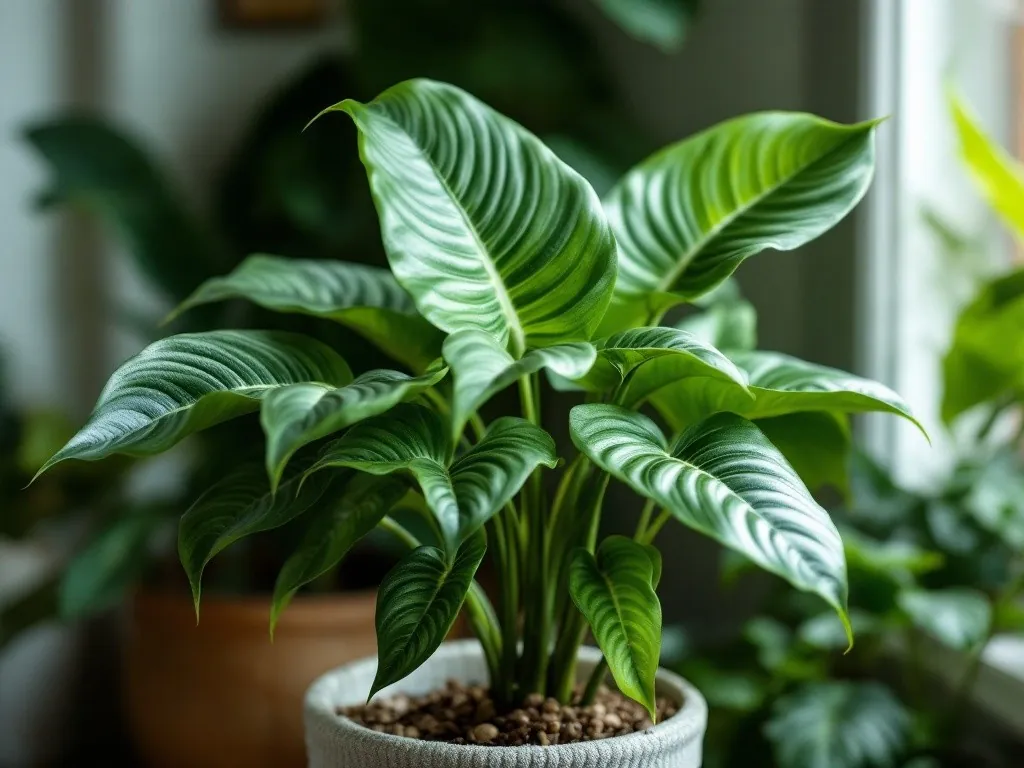
In short
- Blooms with white flower spikes almost year-round under good conditions.
- Tolerates partial shade and shade — good for low-light rooms.
- Signals thirst by drooping leaves and recovers quickly once watered.
- Appreciates high air humidity — does well in bathrooms.
- Toxic to dogs and cats if chewed.
Botanical data
- Family
- Araceae (Araceae)
- Height
- 0.4–0.7 m
- Width
- 0.3–0.6 m
- Habit
- Clump-forming
- Growth rate
- Moderate
- Position
- Partial shade, Shade
- Soil
- Humus-rich
- pH reaction
- pH 5.5–6.5
- Moisture
- Moist
- Bloom
- March–September
- Hardiness
- USDA 10a–11b
- Propagation
- By division
Characteristics
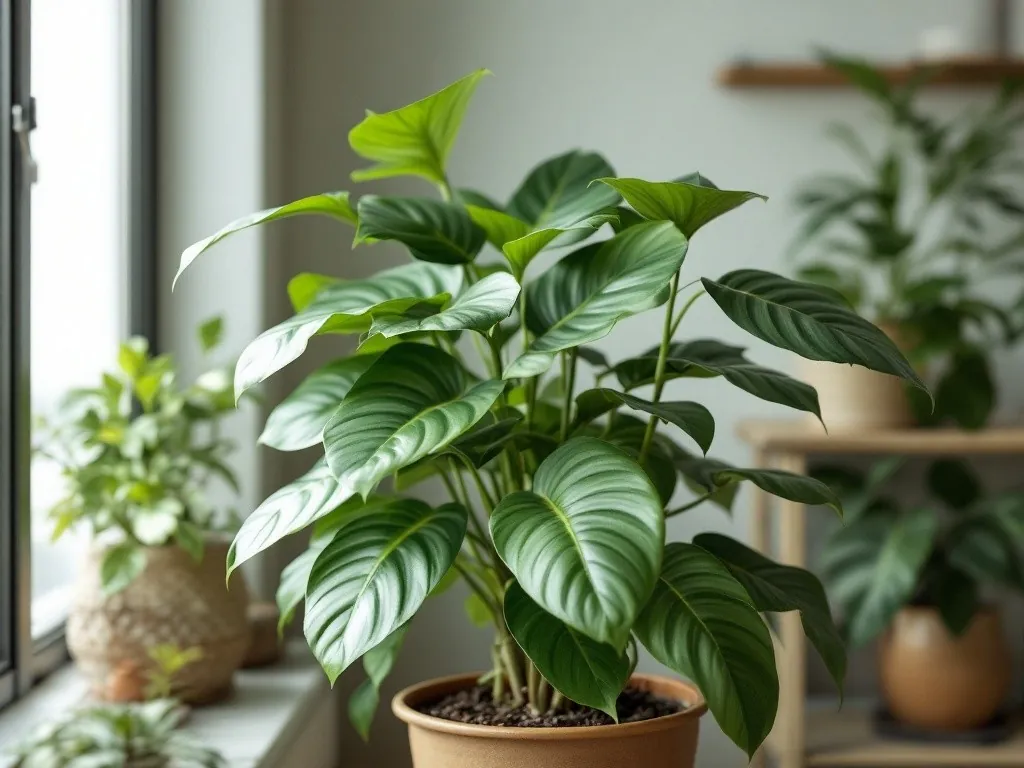
A clump-forming plant with glossy, lance-shaped, dark green leaves. Its inflorescence, typical of the arum family, consists of a white spathe surrounding a creamy spadix, borne on a tall stalk above the leaves.
Growing and care
Watering
Clearly signals thirst by drooping leaves and recovers quickly once watered. Appreciates humid air.
Fertilizing
Moderate fertilizing supports flowering; too much limits flower formation.
Planting
Free-draining, humus-rich substrate that holds moisture; a pot with drainage.
Pruning
Remove spent flower spikes and yellowing leaves right at the base.
Companion plants
Good companions
Similar requirements — partial shade and high air humidity; they thrive together in a bathroom.
Bad companions
Vastly different water needs — the peace lily requires constant moisture.
The evidence level indicates whether the relationship is backed by research, observation, or gardening tradition.
Diseases and pests
Small (1–3 mm) soft-bodied insects, green, black or pink, feeding in clusters on young shoots and the underside of leaves. They excrete sticky honeydew.
Spider mitesTiny (0.3–0.5 mm) arachnids, hard to spot with the naked eye, feeding on the underside of leaves. Symptoms: fine, pale speckling (feeding punctures); over time the leaves turn grey, yellow and dry out. Under heavy infestation a fine webbing becomes visible. Warm, dry air favours their development — a common problem for houseplants in winter near radiators.
MealybugsInsects covered in a white, cottony, waxy coating, gathering in leaf axils, at the base of shoots and on the underside of leaf blades. They look like tufts of cotton wool. They suck sap, weaken the plant and excrete sticky honeydew, on which black sooty mould develops. A common pest of houseplants and succulents.
Fungus gnatsSmall, dark gnats (2–4 mm) flying around pots and scurrying across the surface of the substrate. The adults are a nuisance, but the real damage is done by their larvae in the soil, feeding on the roots and the base of the stems of young plants. A constantly moist, humus-rich substrate favours their development — the classic result of overwatering houseplants.
Toxicity
| For whom | Level | Notes |
|---|---|---|
| Humans | Mild | Contains calcium oxalates that irritate the mouth if ingested. |
| Dogs | Moderate | — |
| Cats | Moderate | — |
History and origin
The peace lily entered European cultivation in the 19th century from the American tropics. It became popular as one of the few plants that flower attractively even in low indoor light.
Uses
For living rooms and offices with moderate or low light, especially bathrooms, thanks to its liking for humid air.
Trivia
- The peace lily is among the plants most often cited in NASA studies for purifying air of formaldehyde and benzene.
- What looks like a white flower is actually a modified leaf (spathe) — the true flowers are tiny structures on the spadix.
Frequently asked questions
Why won't my peace lily bloom?
The most common causes are too little light (despite its shade tolerance, it needs bright, indirect light to flower) or too much nitrogen in the fertilizer at the expense of phosphorus.
Why do peace lily leaves get brown tips?
This is usually caused by air that's too dry, a root ball that's dried out, or an excess of mineral salts from tap water. Misting and watering with settled water usually helps.
My peace lily's leaves have drooped — is it dying?
Usually not — this is a typical sign of thirst. After watering, the plant usually regains its firmness within a few hours.
Sources
- Plants of the World Online (POWO)Database (GBIF, POWO…)
- RHS — SpathiphyllumInstitution / botanical garden
My note
A private note for this plant — saved in your browser.