In short
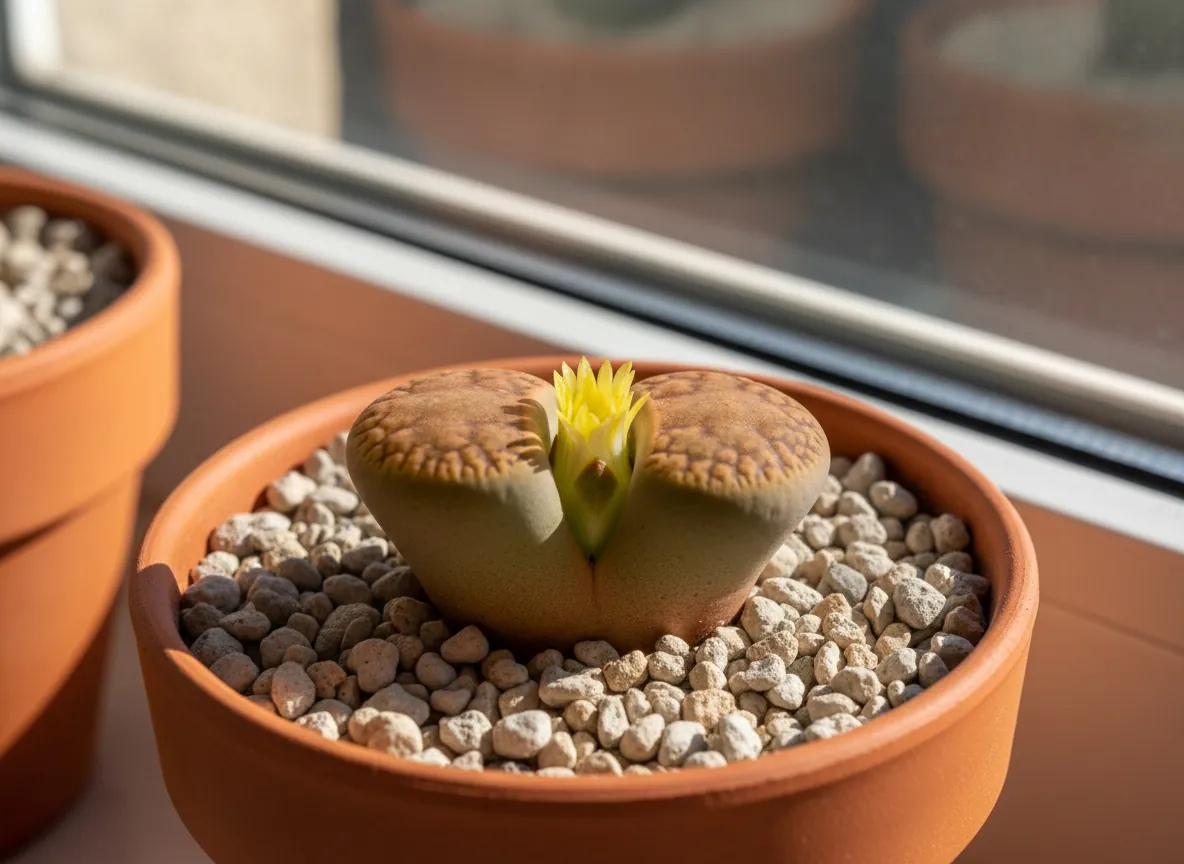
- The whole plant is ONE pair of thick leaves with a flat “window” at the top — the rest sits in the gravel.
- The watering cycle is rigid: water only in late summer and autumn, complete drought in winter.
- DO NOT WATER during the leaf change (winter–spring) — the plant is then consuming the old pair and will split if watered.
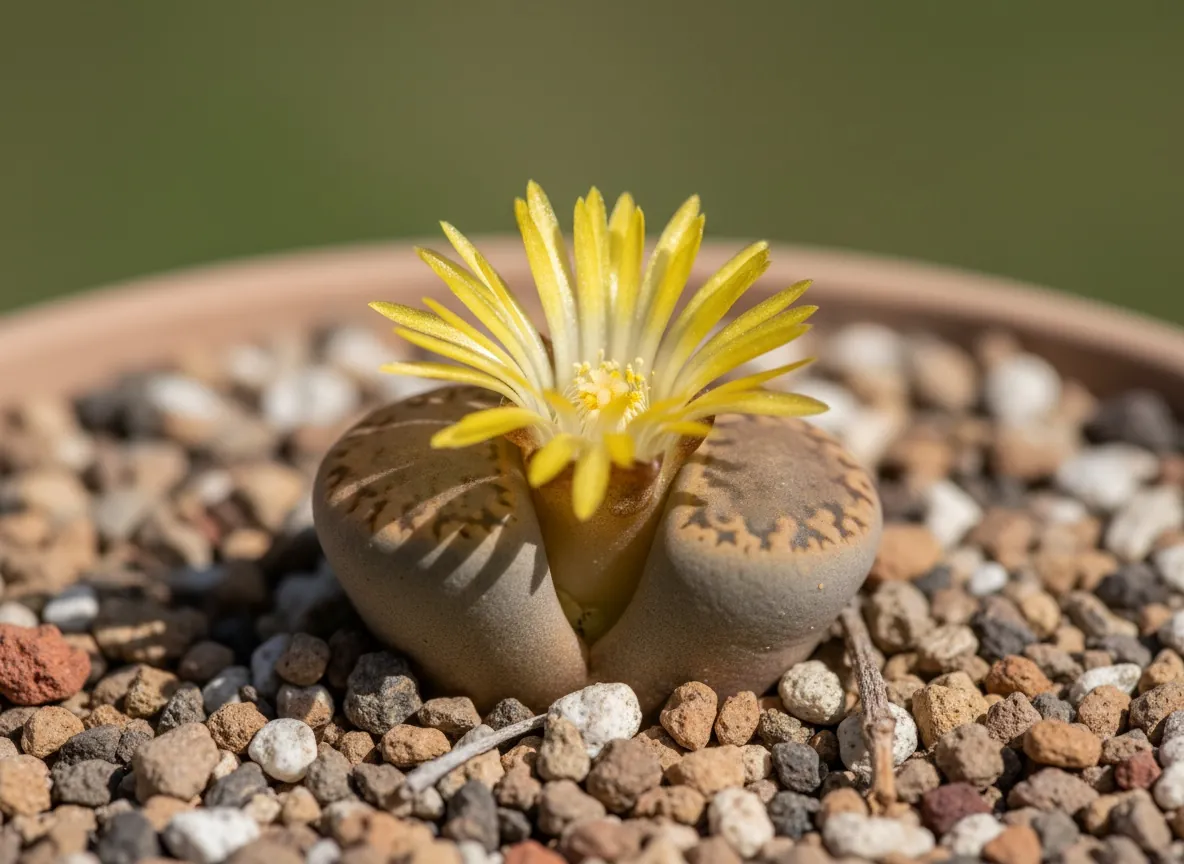
- Flowers in autumn — a single, large yellow or white flower emerges from the slit between the leaves.
- Requires an extremely mineral substrate and a deep pot (long taproot).
- Strictly a pot plant, for the sunniest windowsill; well grown, it lives for several decades.
Botanical data
- Family
- Aizoaceae (Aizoaceae)
- Height
- 0.02–0.05 m
- Width
- 0.02–0.06 m
- Habit
- Clump-forming
- Growth rate
- Slow
- Position
- Full sun
- Soil
- Sandy
- pH reaction
- pH 6–7.5
- Moisture
- Dry
- Bloom
- September–November
- Hardiness
- —
- Propagation
- From seed, By division
Characteristics
A plant almost without a stem, reduced to a pair of very thick leaves fused at the base and separated by a narrow slit. Only the flat upper surface is visible above the gravel — the so-called window — with a marbled pattern in shades of grey, brown, olive and rust, perfectly imitating the surrounding pebbles. The window is translucent and lets light into the interior of the leaf, where the assimilating tissue lies: the plant therefore photosynthesises underground, protecting itself from the heat and from herbivores. In autumn a single, large (2–4 cm), daisy-like flower grows out of the slit — yellow, in some forms with a white centre — often larger than the plant itself. Each year a new pair bursts open the interior of the leaf pair, feeding on the resources of the old one, which dries to a parchment-like husk.
Growing and care
Watering
Watering is governed by the calendar, not by instinct. Water ONLY during the growth period: in late summer and autumn (August–October, before and during flowering), and sparingly in late spring. COMPLETELY DRY from November until spring and throughout the entire leaf change — the plant then draws water from the old pair of leaves and, if watered, splits or rots. Water sparingly, between the leaves, when the substrate is dry all the way through.
Fertilizing
At 1/4 of the recommended concentration, or not at all — living stones grow in almost sterile gravel, and when fed they swell, split and lose their stony appearance.
Planting
An extremely mineral substrate: coarse sand, pumice, perlite and fine gravel with a minimal addition of soil (mineral proportion about 70–80%). The pot MUST be deep (min. 8–10 cm) — the living stone has a surprisingly long taproot. Cover the surface with gravel so that the plant protrudes above it only with its window.
Pruning
Leave the old, shrivelled pair of leaves to dry out completely into a parchment-like husk; it can then be gently removed with the fingers if it has not fallen off by itself.
Companion plants
Good companions
An identical, very unusual watering cycle — only plants with the same rhythm of drought and growth can be kept in one bowl without killing one of them.
It tolerates the same mineral substrate and full sun, and forgives drought as well — a safe neighbour, if it stands alongside in a separate pot.
Bad companions
Although it too is a succulent, it has a completely different rhythm: it needs water in summer, when the living stone is resting, and more regularly throughout the season — in a shared bowl one of the plants always gets water at the wrong moment.
A shared substrate kept moist causes the living stone to split and rot within a few weeks — its cycle depends on complete drought lasting many months.
The evidence level indicates whether the relationship is backed by research, observation, or gardening tradition.
Toxicity
| For whom | Level | Notes |
|---|---|---|
| Humans | None | A non-toxic plant; it contains no known harmful substances. |
| Dogs | None | — |
| Cats | None | — |
History and origin
Living stones were discovered for science by accident: in 1811 the British explorer William John Burchell, picking up an “interesting pebble” in the South African bush, realised he was holding a plant. Their camouflage is the result of herbivore pressure in a landscape where succulent tissue full of water is literally worth a life — being indistinguishable from gravel proved more effective than spines. The species Lithops lesliei, described at the beginning of the 20th century, is one of the most widely distributed in the wild and the most commonly cultivated representative of the genus. Among succulent collectors, living stones have the status of cult plants — easy to buy, hard to keep for years.
Uses
A collector's plant for the sunniest windowsills, for shallow bowls and gravel desert compositions, where the effect of a “bowl of pebbles from which a flower suddenly grows” makes the greatest impression. Because of their very unusual watering cycle, living stones are best kept in separate pots or exclusively in the company of plants with an identical rhythm — not in communal arrangements with other succulents.
Trivia
- The living stone grows “upside down” relative to our intuition: almost the entire plant sits in the substrate, and only the translucent window protrudes above the gravel, letting light into the interior of the leaf. Photosynthesis therefore takes place below the surface of the ground.
- Each year the plant eats itself: a new pair of leaves develops inside the old one and draws water and nutrients from it until the old pair dries to a papery husk. That is why watering during this period is lethal — the water supplied swells the new pair, which then splits or rots.
- The name Lithops comes from the Greek words lithos (stone) and ops (appearance) — literally “stone-looking”. The camouflage is so effective that the first specimen was discovered by accident, while trying to pick a pebble up off the ground.
Frequently asked questions
How often should I water a living stone?
Far less often than instinct suggests — and only within specific windows of time. Water is given during the growth period, that is in late summer and autumn (roughly August–October, before and during flowering), and very sparingly in late spring. From November until spring, and throughout the entire leaf change, the living stone is kept COMPLETELY dry. Even in season it is watered sparingly, and only once the substrate is dry all the way through.
The old leaves of my living stone are shrivelling and drying up — is the plant dying?
No, this is the normal, annual leaf change. A new pair develops inside the old one and draws water and nutrients from it until the old pair dries to a parchment-like husk. The most important things during this period: do not water (the water supplied swells the young pair, which then splits or rots) and do not pull off the old leaves while they are even slightly fleshy. The dry husk can be gently removed with your fingers once it fails to come away by itself.
Why is my living stone swelling, going pale and falling over?
This is the classic symptom of excess water and insufficient light, often combined with soil that is too fertile. The living stone naturally grows in almost sterile gravel in full sun, so in shade and in moist substrate it elongates, loses its stony pattern, and its soft body splits. The remedy: move it to the sunniest windowsill, repot it into a 70–80% mineral substrate in a deep pot (long taproot), and return to the rigid watering calendar.
Sources
- Plants of the World Online (POWO)Database (GBIF, POWO…)
- Missouri Botanical Garden — LithopsInstitution / botanical garden
My note
A private note for this plant — saved in your browser.