In short
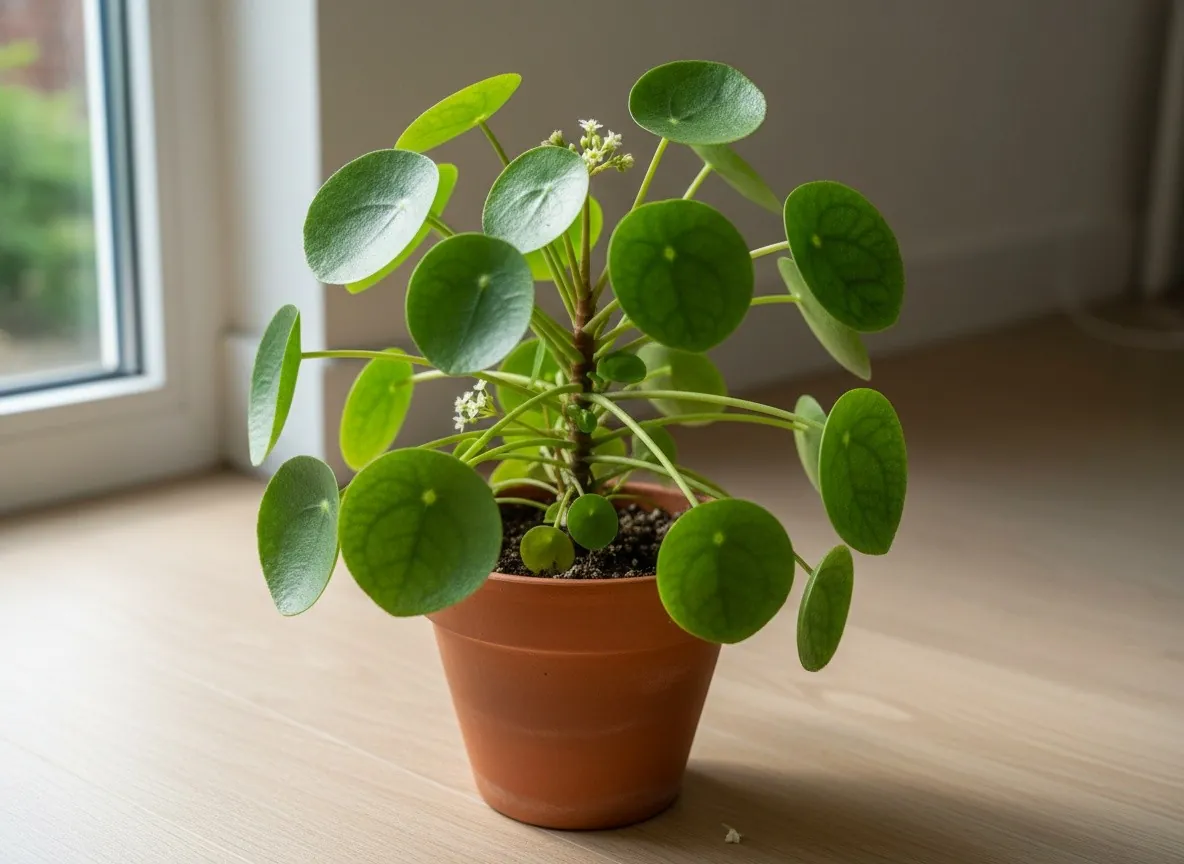
- Round, glossy leaves resembling coins or pizza discs, each on its own long stalk.
- Easy to grow – tolerates drying out better than overwatering.
- Needs bright, indirect light without harsh sun.
- Safe for children, dogs and cats – non-toxic.
- Side shoots ('pups') form around the mother plant and are easy to detach and root.
- Hugely popular in recent years among young plant collectors and on social media.
Botanical data
- Family
- Urticaceae (Urticaceae)
- Height
- 0.2–0.4 m
- Width
- 0.2–0.3 m
- Habit
- Upright
- Growth rate
- Moderate
- Position
- Partial shade
- Soil
- Humus-rich
- pH reaction
- pH 6–7
- Moisture
- Moderate
- Bloom
- —
- Hardiness
- USDA 10a–11b
- Propagation
- From cuttings, By division
Characteristics
A herbaceous plant with a single, upright stem from which round, fleshy, slightly convex leaves 5–10 cm across grow on long, slender stalks. The flowers are small and pinkish-white, gathered in small umbel-like clusters, and rarely appear in indoor conditions.
Growing and care
Watering
Water when the top layer of substrate has dried out to a depth of 2–3 cm. Overwatering is a more common problem than drying out.
Fertilizing
Fertiliser diluted to half the manufacturer's dose – the pilea copes easily with underfeeding, but less well with an excess of mineral salts.
Planting
Universal substrate for foliage plants with added perlite for drainage.
Pruning
Remove yellowing leaves at the base of the stalk; cut off side shoots ('pups') for propagation.
Companion plants
Good companions
Similar requirements for air humidity and moderate, diffuse light – an easy shared position on the same window.
The evidence level indicates whether the relationship is backed by research, observation, or gardening tradition.
Diseases and pests
Small (1–3 mm) soft-bodied insects, green, black or pink, feeding in clusters on young shoots and the underside of leaves. They excrete sticky honeydew.
Spider mitesTiny (0.3–0.5 mm) arachnids, hard to spot with the naked eye, feeding on the underside of leaves. Symptoms: fine, pale speckling (feeding punctures); over time the leaves turn grey, yellow and dry out. Under heavy infestation a fine webbing becomes visible. Warm, dry air favours their development — a common problem for houseplants in winter near radiators.
Toxicity
| For whom | Level | Notes |
|---|---|---|
| Humans | None | Widely regarded as a safe houseplant, non-toxic to humans. |
| Dogs | None | — |
| Cats | None | — |
History and origin
It was described for European botany in the early 20th century, but entered wider cultivation thanks to a Norwegian missionary who brought a cutting from China to Scandinavia in the 1940s. For decades it passed between homes mainly as a gift from friend to friend, before becoming a viral social-media hit in the 2010s.
Uses
For bright living rooms and offices as a small specimen plant on a desk, shelf or windowsill. It looks good in groups of pots of different ages, thanks to how easily it is propagated from pups.
Trivia
- The plant is so strongly associated with informal gift-giving that in Scandinavia it is sometimes called the 'friendship plant' – owners traditionally give cuttings from the pups to their loved ones, rarely buying it in a shop.
- The side shoots ('pups') that form at the base of the mother plant's stem can easily be cut off and rooted in water or moist substrate – this is the main way the pilea has spread worldwide, virtually without the involvement of the horticultural trade.
- The name 'UFO plant' comes from the round leaf shape resembling a flying saucer seen from the side, as the stalk is attached centrally on the underside of the blade.
Frequently asked questions
Why do the leaves of my pilea lose their round shape and curl?
Usually this is the effect of one-sided light – the pilea bends its stalks strongly towards the source of brightness. It is worth turning the pot regularly by about 90 degrees to keep the symmetrical, round habit.
What should I do with the small shoots growing out of the soil around the plant?
These are the natural pups of the pilea. Once they reach a few centimetres, you can cut them off together with a piece of root, or break them off and root them separately in water – after a few weeks they will produce their own roots.
Is the pilea safe for a cat that nibbles the leaves?
Yes, the Chinese money plant is generally regarded as non-toxic to cats and dogs, unlike many other popular houseplants from the arum family.
Sources
- Plants of the World Online (POWO)Database (GBIF, POWO…)
- RHS — Pilea peperomioidesInstitution / botanical garden
My note
A private note for this plant — saved in your browser.