In short
- Very easy to grow — it forgives forgotten watering and weaker light.
- Thickened roots store water, thanks to which it withstands short droughts.
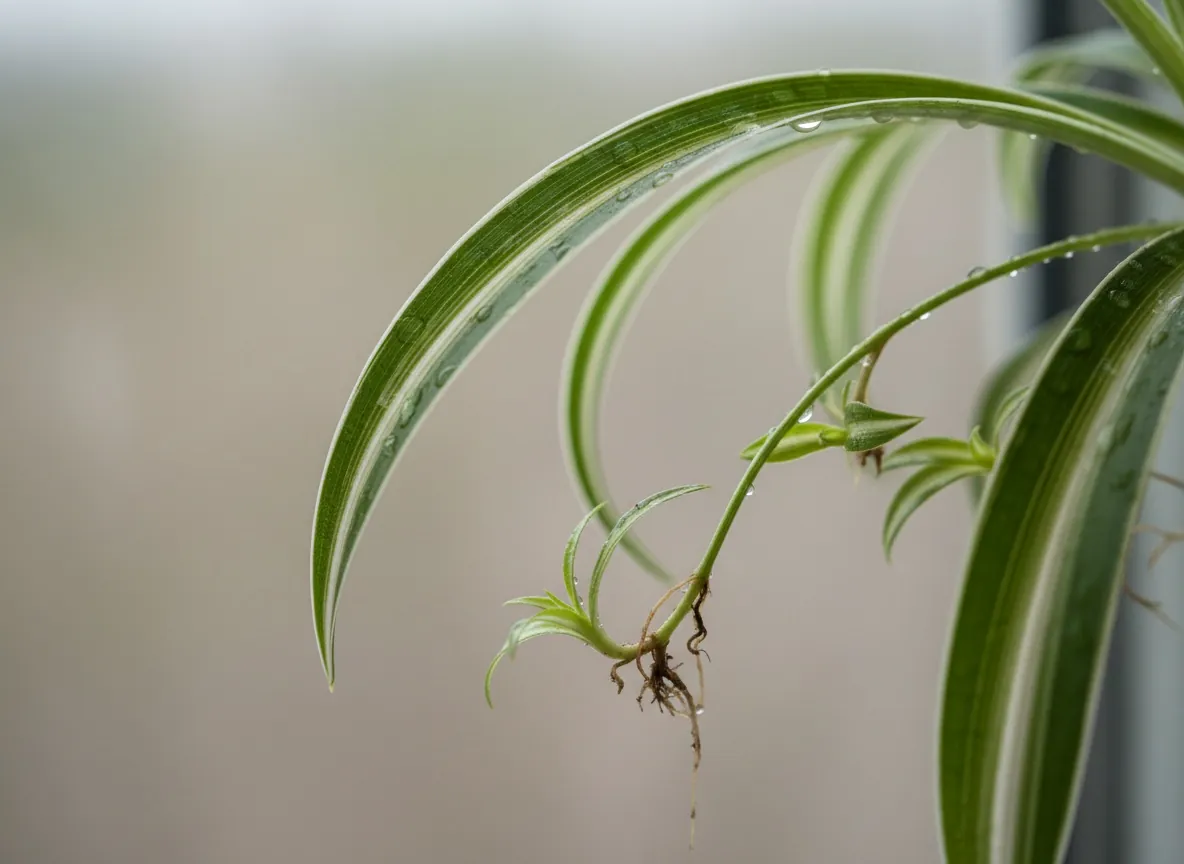
- It propagates itself: young plants grow on the trailing runners.
- Brown leaf tips are most often a reaction to fluoride in tap water.
- Completely non-toxic — safe for cats, dogs and children.
Botanical data
- Family
- Asparagaceae (Asparagaceae)
- Height
- 0.2–0.4 m
- Width
- 0.3–0.6 m
- Habit
- Clump-forming
- Growth rate
- Fast
- Position
- Partial shade, Shade
- Soil
- Humus-rich, Sandy
- pH reaction
- pH 6–7
- Moisture
- Moderate
- Bloom
- May–September
- Hardiness
- —
- Propagation
- By runners, By division, From cuttings
Characteristics
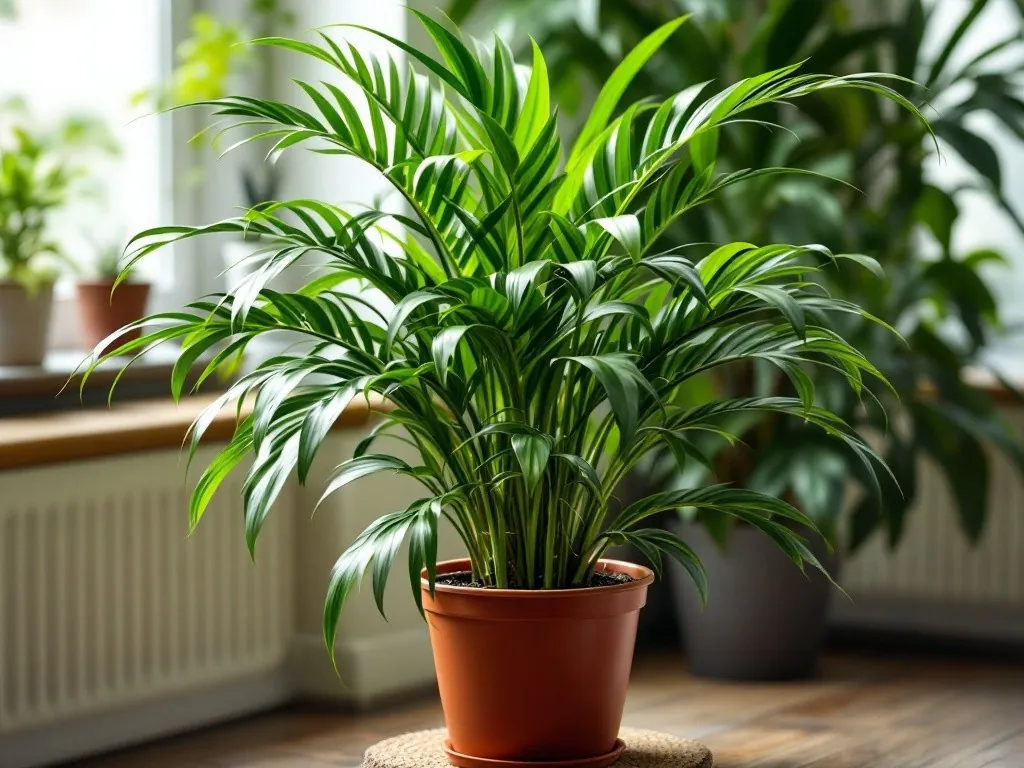
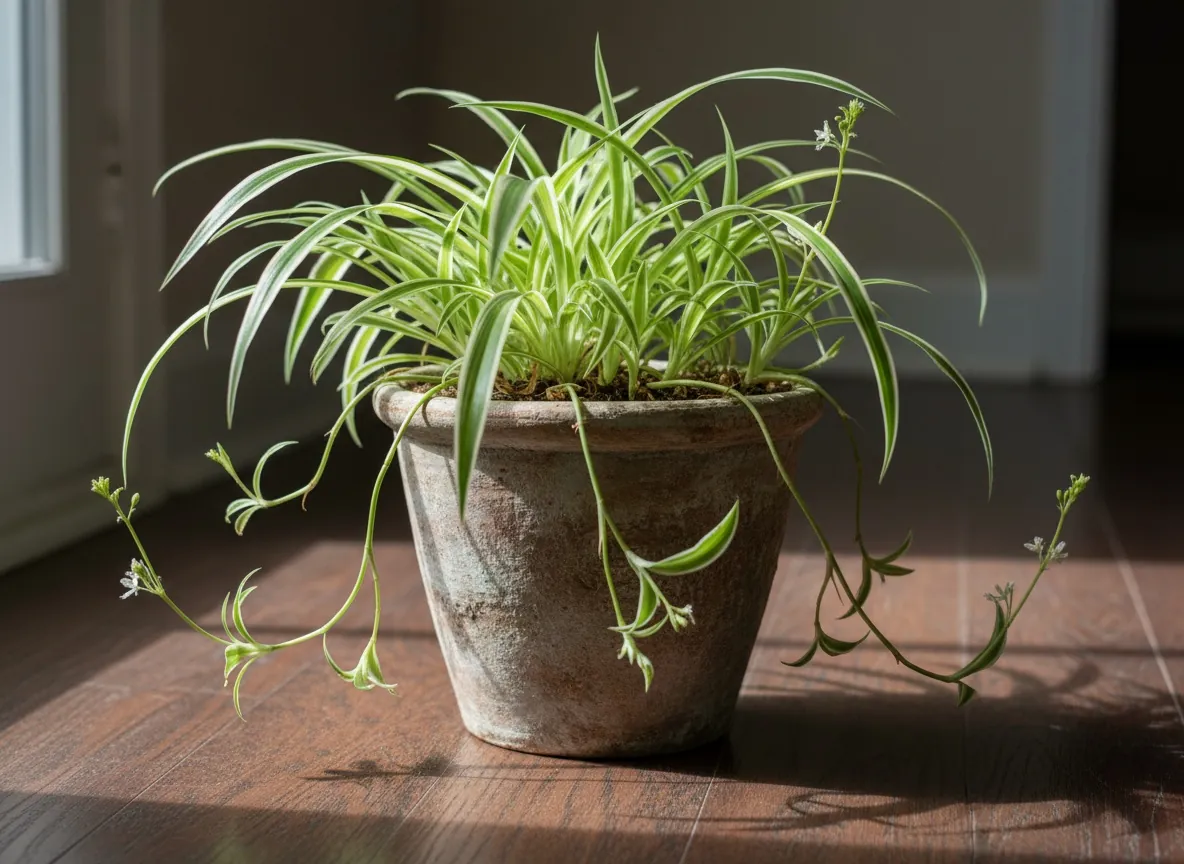
It forms a dense rosette of narrow, arching leaves 20–40 cm long, in most ornamental cultivars with a white or cream stripe along the centre or at the margin. Below ground it produces thick, swollen roots that store water. In summer it puts out long, trailing runners with small white flowers, and after these have finished — with miniature daughter plants which need only be cut off and rooted.
Growing and care
Watering
Thickened, tuberous roots store water, thanks to which the spider plant forgives forgotten watering. Sensitive to fluoride and chlorine from tap water — it responds with browning leaf tips, so stood or rain water is best.
Fertilizing
Half the manufacturer's dose — the spider plant grows fast even without intensive fertilising, and an excess of salts in the substrate intensifies the browning of the leaf tips.
Planting
Ordinary universal substrate with added perlite; a pot with drainage, rather wide than deep. The spreading roots can burst a thin pot — this is a normal signal to repot.
Pruning
Remove dried leaves at the base; brown tips can be trimmed with scissors along the natural shape of the leaf. Cut off runners with plantlets once the young plants have put out their own roots.
Companion plants
Good companions
The two most forgiving trailing plants — the same light and water requirements, and they look excellent side by side on a hanging shelf.
Similar tolerance of partial shade and a comparable watering rhythm; the contrast between the spider plant's narrow leaves and the philodendron's heart-shaped ones complements each other well.
Both plants tolerate diffused light and are easy to grow; together they form a simple composition for a less well-lit room.
Bad companions
They require full sun and very infrequent watering; in such conditions the spider plant's leaves fade and scorch at the tips.
The evidence level indicates whether the relationship is backed by research, observation, or gardening tradition.
Toxicity
| For whom | Level | Notes |
|---|---|---|
| Humans | None | A non-toxic plant — it contains neither the calcium oxalates nor the latex typical of many house plants. |
| Dogs | None | Regarded as safe. Eating a large quantity of leaves may at most mechanically irritate the stomach, like any indigestible greenery. |
| Cats | None | One of the most frequently recommended plants for a home with a cat — non-toxic. Cats readily nibble it and play with the trailing runners, which can be a nuisance for the plant but is not dangerous for the animal. |
History and origin
The species comes from southern Africa, and its Polish name commemorates Kaspar Maria von Sternberg — the Czech botanist and palaeobotanist of the turn of the 18th and 19th centuries, co-founder of the National Museum in Prague. In Europe the spider plant spread in the 19th century and became one of the most widely grown house plants, chiefly because it is easy to pass on to friends in the form of ready-made plantlets.
Uses
For living rooms and offices with diffused light, especially for hanging pots and high shelves from which the runners hang freely. In summer it can be moved to a sheltered balcony. Because of its lack of toxicity it is one of the best suggestions for a home with a cat or a small child.
Trivia
- The spider plant appears in the air-purification research of the 1980s as a plant that binds formaldehyde — it is worth knowing, however, that the effect was measured in sealed laboratory chambers and in an ordinary home it is negligible.
- The trailing runners with young plantlets are ready-made clones of the mother plant: it is enough to stand them in water or pin them into a neighbouring pot for them to root on their own within a few weeks.
Frequently asked questions
Why does the spider plant have brown leaf tips?
Most often the fluoride and chlorine contained in tap water are responsible, to which the spider plant is exceptionally sensitive. Watering with stood, boiled or rain water helps, as does limiting fertilisation, because a salinated substrate intensifies the symptom. A second cause is very dry air near a radiator.
How do you propagate the spider plant from the plantlets on the runners?
Wait until the young plantlet at the end of the runner puts out the beginnings of its own roots, then cut it off and stand it in water or plant it straight into moist substrate. You can also, without cutting the runner, pin the plantlet into a neighbouring pot and sever it only once it has rooted — this method is almost foolproof.
Is the spider plant toxic to cats?
No. The spider plant is among the plants regarded as safe for cats, dogs and people — it contains neither calcium oxalates nor irritating milky sap. Cats readily nibble its leaves and play with the trailing runners; this is usually a problem for the plant's appearance rather than a threat to the animal.
Sources
- Plants of the World Online (POWO)Database (GBIF, POWO…)
- RHS — Chlorophytum comosumInstitution / botanical garden
My note
A private note for this plant — saved in your browser.