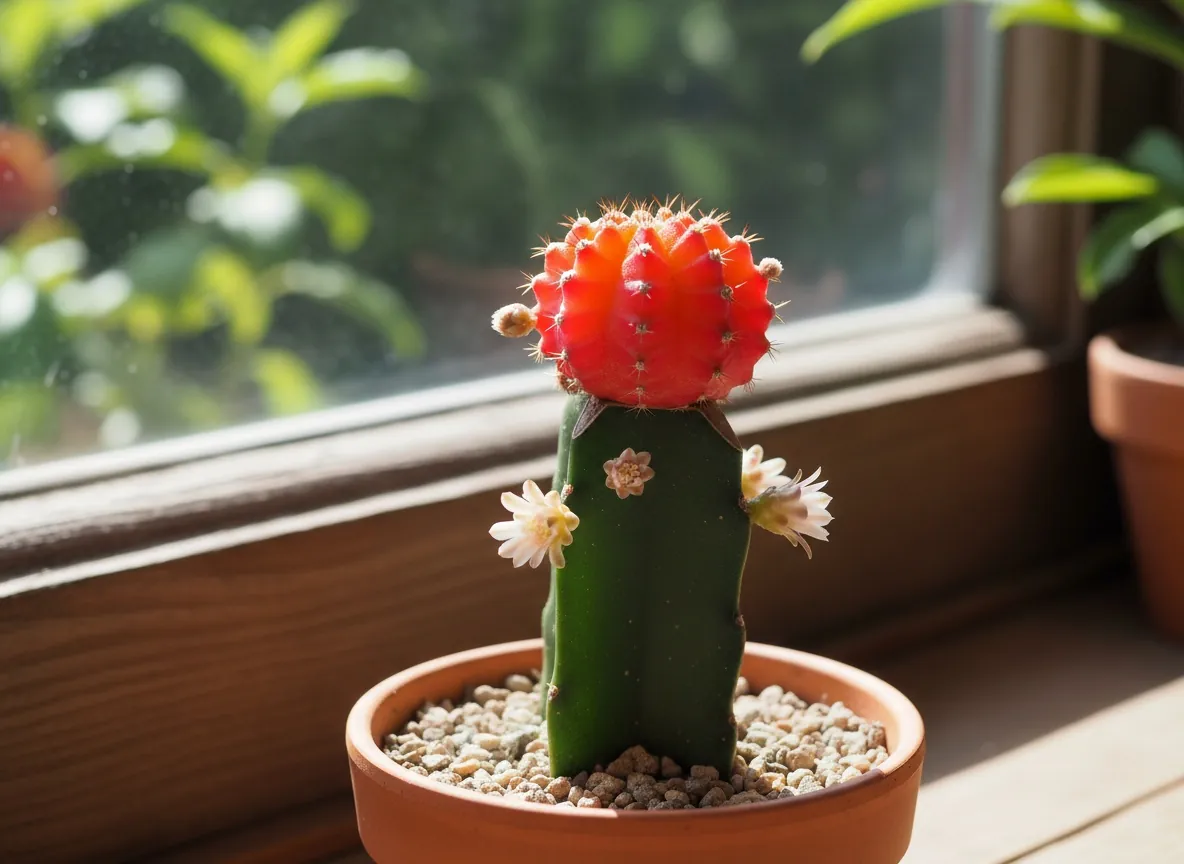
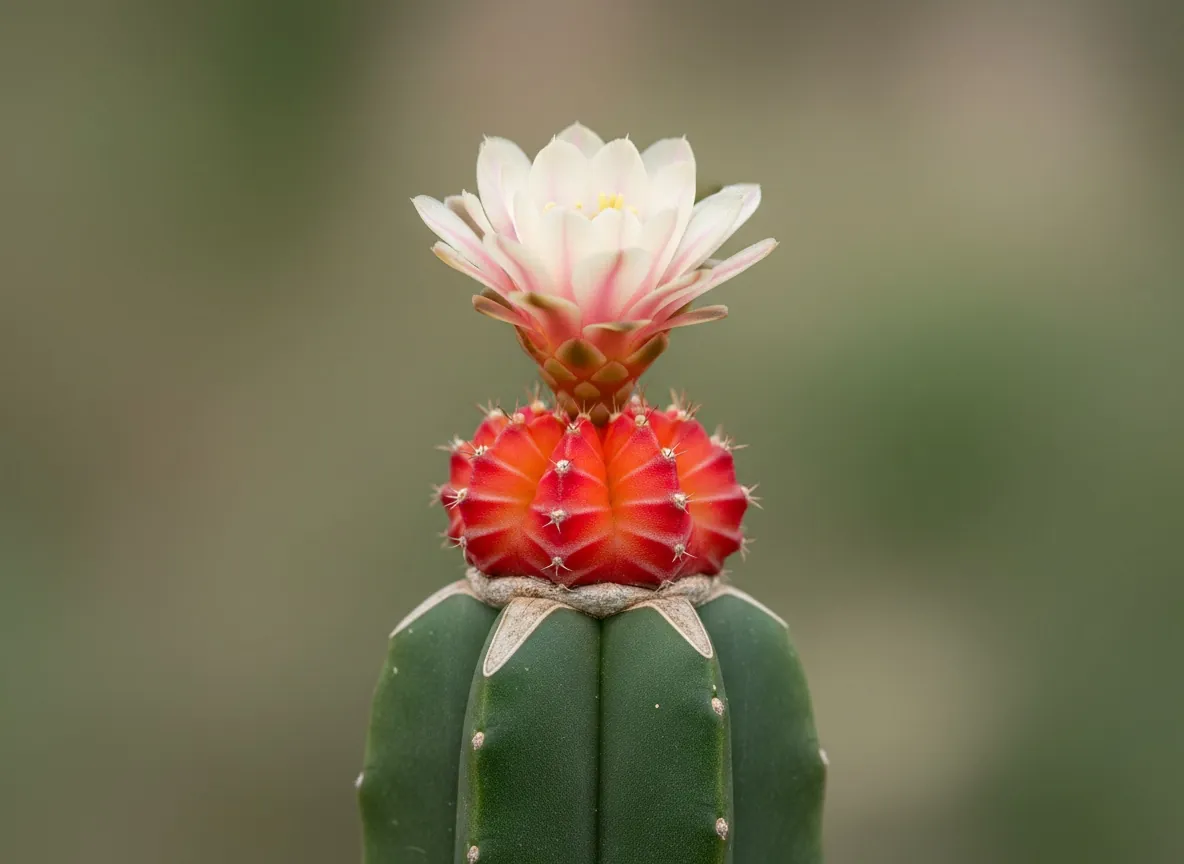
In short
- The colourful balls from garden centres are chlorophyll-free forms — they CANNOT live on their own.
- The green part beneath the ball is a different species (the rootstock, usually Hylocereus) — these are two plants.
- A colourful ball cut off and set in soil will always rot — without chlorophyll it cannot feed itself.
- A grafted plant overwinters according to the requirements of the ROOTSTOCK: 12–15°C, not entirely dry.
- The typical form (green-brown) grows normally on its own roots and overwinters like a cactus.
- It prefers partial shade — it comes from scrub, not open desert; in harsh sun it scorches.
Botanical data
- Family
- Cactaceae (Cactaceae)
- Height
- 0.04–0.08 m
- Width
- 0.05–0.1 m
- Habit
- Rounded
- Growth rate
- Slow
- Position
- Full sun, Partial shade
- Soil
- Sandy, Humus-rich
- pH reaction
- pH 5.5–7
- Moisture
- Dry, Moderate
- Bloom
- May–August
- Hardiness
- —
- Propagation
- From seed, From cuttings
Characteristics
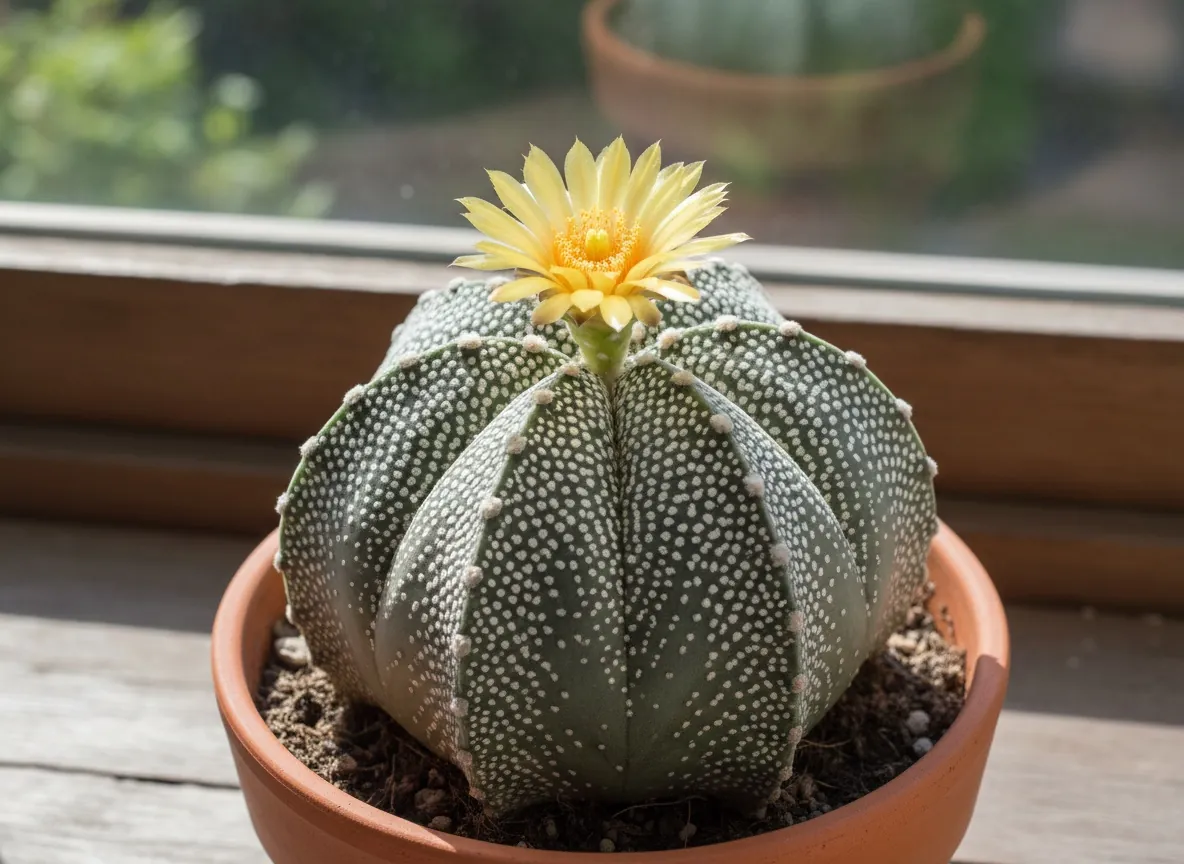
A cactus with a flattened-globular body 5-10 cm across, with just 8 broad, rounded ribs, distinctly bulged beneath the areoles into the characteristic “chins” to which the plant owes its English name chin cactus. The typical form is grey-green to brownish red, with a delicate transverse banding of the skin; the spines are few, short, slightly curved and not very troublesome. The distinguishing feature of the whole genus is the structure of the bud: the flower tube and ovary are completely naked, without spines, hairs or felt, which gave rise to the name Gymnocalycium — from the Greek gymnos (naked) and kalyx (calyx). The flowers are funnel-shaped, 4-6 cm long, in shades of cream, pale yellow and muted pink, and appear in summer on plants a few years old. The chlorophyll-free forms (the most famous being the Japanese 'Hibotan') have a red, orange, yellow or pink body and lack the green pigment — which is why they exist solely grafted onto a green rootstock.
Growing and care
Watering
Overwintering depends on WHAT is actually standing in the pot, and this is the most common source of mistakes. The green form on its own roots overwinters like a typical cactus: 8–12°C, completely dry, from November to March without water. A grafted plant (a colourful ball on a green rootstock) is governed by the laws of the ROOTSTOCK, and that is usually the tropical Hylocereus, which tolerates neither cold below 10–12°C nor complete drying out — such a plant must not be exposed to a cold winter rest; it is kept at 12–15°C and watered very sparingly about once a month. In the growing season water both variants once the root ball has dried out.
Fertilizing
At the recommended concentration and only in the growing season. In grafted plants, feeding in effect feeds the rootstock — excess nitrogen accelerates its growth, so that it outgrows the scion faster and “throws off” the colourful ball.
Planting
A free-draining cactus substrate with a light addition of humus and a large proportion of grit or perlite; the species prefers a slightly acidic reaction, so avoid calcareous grit. With a grafted plant, set it so that the graft union (the visible horizontal line between ball and rootstock) remains clearly above the substrate — buried, it starts to rot.
Pruning
At most, separating offsets in spring for propagation; in grafted plants one removes the offsets emerging from the rootstock below the graft union, because they take strength from the colourful ball.
Companion plants
Good companions
A South American cactus tolerating the same slightly acidic substrate and somewhat gentler light — it tolerates sharing a bowl with the green form well.
A cactus with similar soil and water requirements, tolerating the same bright but not extremely sunny position.
A succulent which — like gymnocalycium — grows in nature in the shade of other plants and in cultivation prefers diffuse light to full midday sun.
Bad companions
A desert cactus requiring full, harsh sun and a cold winter rest; in those same conditions the skin of the gymnocalycium — especially of the grafted chlorophyll-free form — scorches and fades.
Grafted specimens overwinter according to the requirements of the Hylocereus rootstock, that is at 12–15°C and not entirely dry — exposed to a cold, dry rest together with desert cacti they lose the rootstock, and with it the whole plant.
The evidence level indicates whether the relationship is backed by research, observation, or gardening tradition.
Toxicity
| For whom | Level | Notes |
|---|---|---|
| Humans | None | A non-toxic plant — the bright red or yellow of the ball has nothing to do with toxicity; these are simply pigments revealed by the absence of chlorophyll. The only hazard is mechanical: the spines are short and not very sharp, but they can prick. |
| Dogs | None | — |
| Cats | None | — |
History and origin
The species was described at the beginning of the 20th century and named after Nicolás Mihanovich, an Argentine shipowner who financed a botanical expedition to Paraguay. The breakthrough came in 1941 in Japan, where the breeder Eiji Watanabe selected chlorophyll-free, entirely red specimens among his seedlings. Under normal conditions such a mutation is a death sentence — a plant without chlorophyll does not photosynthesise and dies as a seedling — but grafted onto a green rootstock, which feeds it as well as itself, it can grow for years. The cultivar was named 'Hibotan' and quickly propagated on an industrial scale. Today red, yellow and pink balls on a green “stem” reach garden centres and florists in millions of units a year, which makes this species probably the most widely sold ornamental cactus in the world — although most buyers do not know that they are holding two fused plants of two different species.
Uses
The typical, green form is a rewarding and undemanding collector's cactus for a bright windowsill without harsh midday sun — it flowers after just a few years and grows on its own roots like any other cactus. The colour forms serve as a decoration rather than a pot plant in the traditional sense: they are striking, cheap and widely available, but their lifespan is limited from the outset by the durability of the rootstock and, with typical domestic care, is counted in years rather than decades. When buying a colourful ball, it is simply worth knowing that you are buying an assembly of two plants and not one — and caring for it according to the needs of the lower one.
Trivia
- The red or yellow ball and the green “stem” beneath it are TWO different plants of two different species, fused by grafting: the upper one is the chlorophyll-free form of Gymnocalycium mihanovichii, the lower usually Hylocereus — a tropical epiphytic cactus, the same genus that gives us the pitaya fruit. Each has different requirements, and the visible horizontal line halfway up is the graft union, not a decoration.
- The colour of the chlorophyll-free forms is not the result of dyeing or modification — those red and yellow pigments are present in every normal cactus, only masked by the green chlorophyll. The mutation removes the chlorophyll and reveals what lay beneath. The price for this effect is high: the plant loses the ability to photosynthesise and will not survive without a rootstock.
- The first chlorophyll-free cultivar 'Hibotan' was selected in 1941 by the Japanese breeder Eiji Watanabe. Since then the combination of “colourful ball on a rootstock” has become one of the most recognisable horticultural products in the world, although its lifespan is limited — usually a few years, after which the rootstock exhausts itself or outgrows the scion.
Frequently asked questions
I bought a red cactus — why is the green part growing while the red ball stands still or dries up?
Because this is not one plant, but two. The red ball is the chlorophyll-free form of Gymnocalycium mihanovichii, and the green “stem” beneath it is an entirely different species — the rootstock, usually the tropical Hylocereus — onto which the ball was grafted. The ball has no chlorophyll, so it does not photosynthesise and receives all its food from the rootstock; by itself it will not grow fast. If the green part is producing offsets or elongating, it is taking strength from the ball — such offsets below the graft union should be removed. If the ball is languishing, drying out or turning brown, it is usually a sign that the rootstock is weakening: it has been overwatered, frosted, or has simply exhausted itself after a few years. The whole assembly has a limited lifespan, usually a few years.
Can I cut off the colourful ball and plant it in soil as a separate plant?
No — this is the most common mistake with this plant and it always ends the same way. The red, yellow and pink forms lack chlorophyll, so they do not photosynthesise and cannot produce a single gram of food for themselves. A ball set in soil will not form functional roots, will live for a few weeks on its own reserves, and will then rot. The only way to save it when the rootstock is failing is to regraft it onto a new, healthy rootstock: you cut the ball off with a clean knife, trim the top of a fresh rootstock and press both surfaces together (with a rubber band or a weight) so that the vascular bundles in the centre of the cut meet. This is feasible at home, though it takes practice. It applies only to the colour forms — the green form has chlorophyll and grows normally on its own roots.
How should a grafted gymnocalycium be overwintered — like other cacti?
No, and this is a very important difference. Overwintering is decided by the rootstock, not by the colourful ball on top. The rootstock is usually Hylocereus — a tropical cactus that tolerates neither cold below 10–12°C nor complete drying out. Exposed to a classic cactus winter rest (8–12°C, no water) it simply freezes and rots, and with it the grafted ball dies. So keep a grafted plant in winter at 12–15°C, in a bright place, and water very sparingly about once a month. The classic dry and cool winter rest applies only to the green form growing on its own roots.
Sources
- Plants of the World Online (POWO)Database (GBIF, POWO…)
- Missouri Botanical Garden — Gymnocalycium mihanovichiiInstitution / botanical garden
My note
A private note for this plant — saved in your browser.