In short
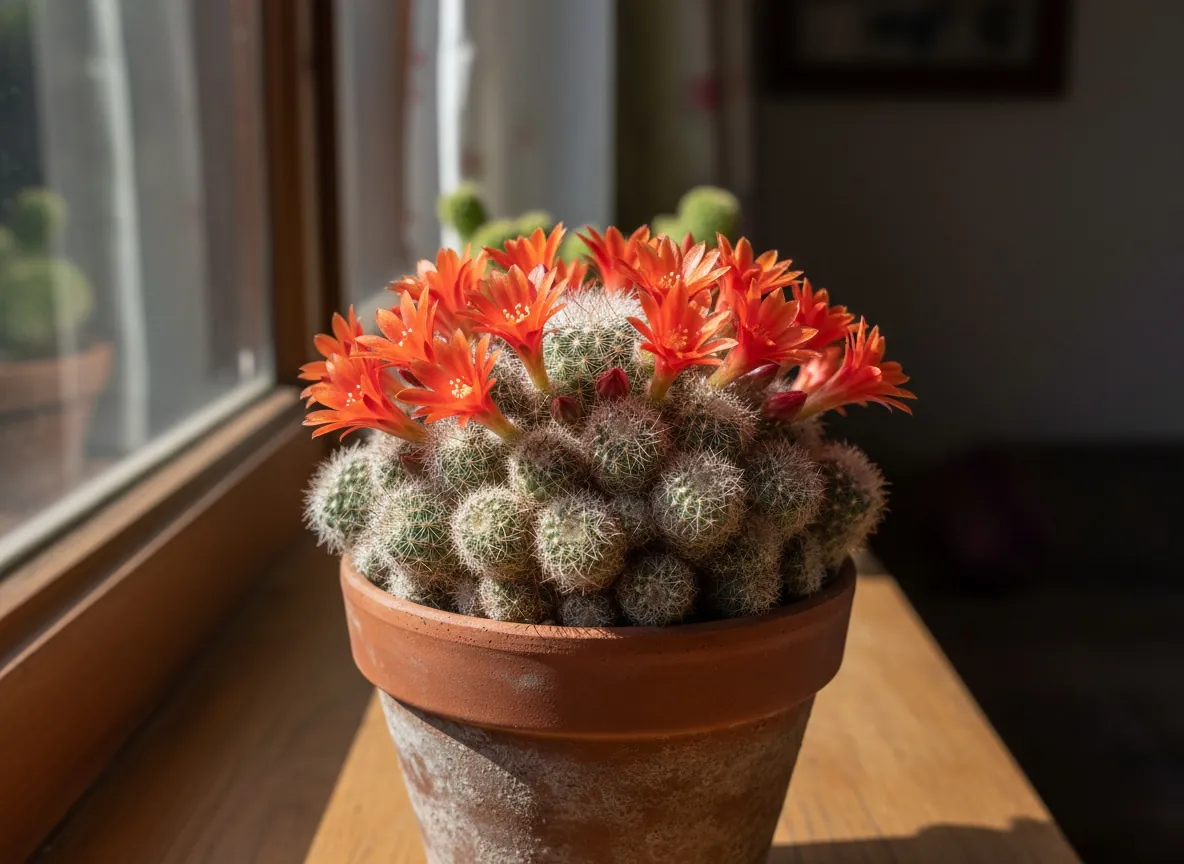
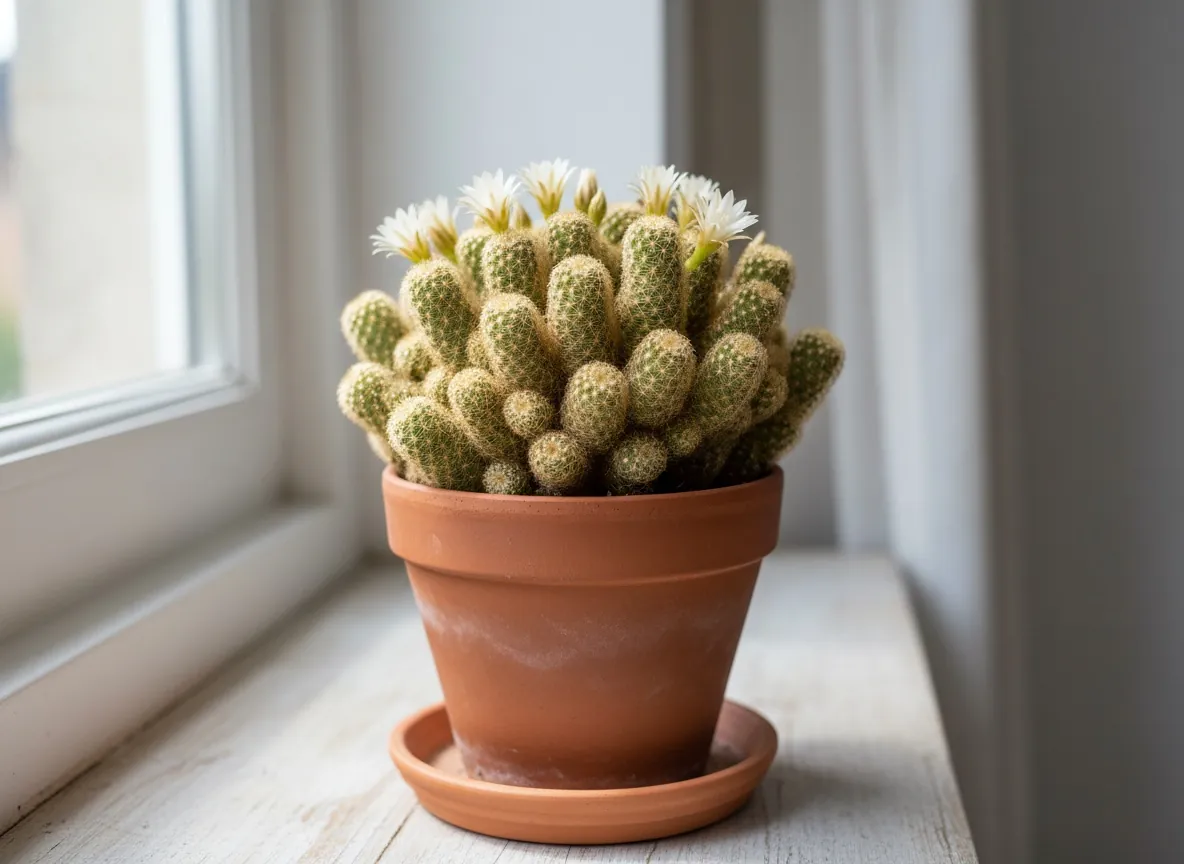
- Forms a clump of finger-like stems (8–15 cm) densely covered with stars of golden spines — hence the name “golden lace”.
- A dry, cool overwintering (8–12 °C, without watering) is the condition for spring flowering.
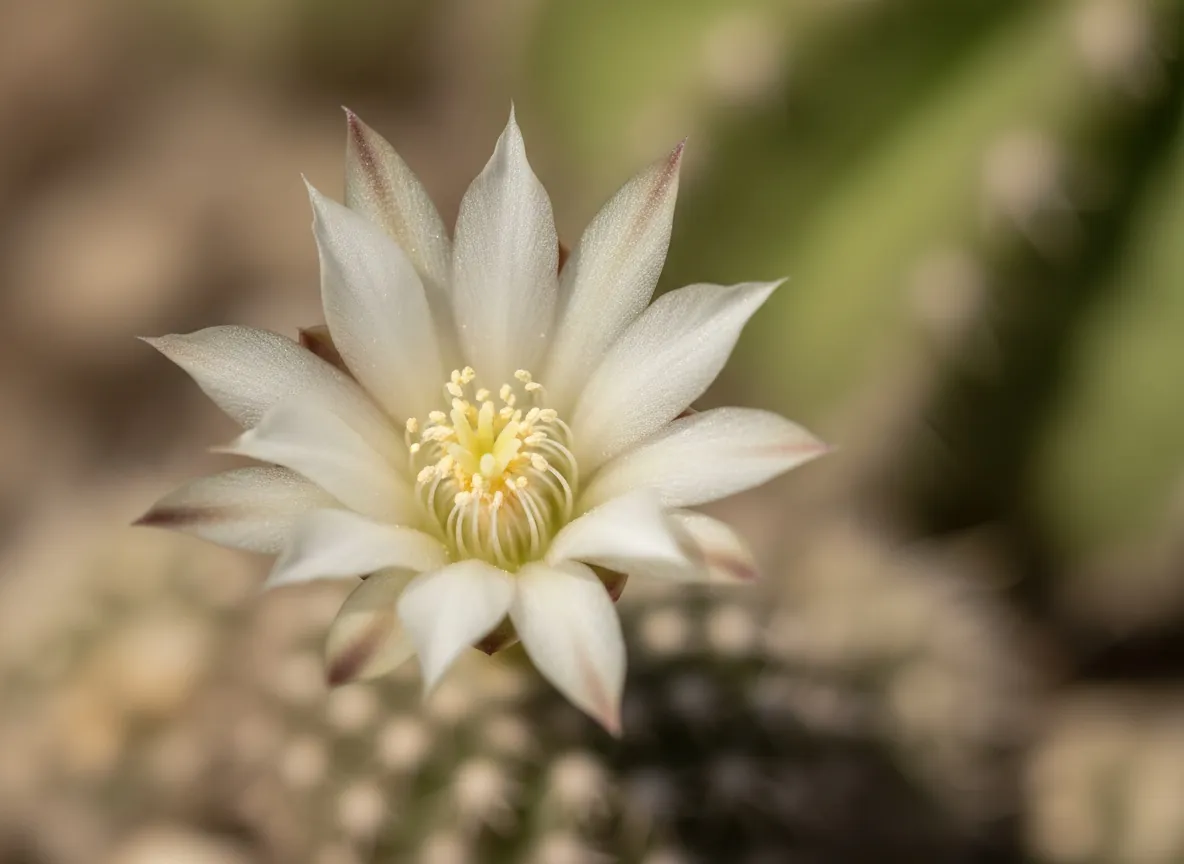
- The flowers are small, cream to pink, in a ring around the top of the stem, in spring.
- Strictly a pot cactus; requires a mineral, free-draining substrate with added calcium.
- Propagation is trivially simple — a broken-off stem roots after a few weeks.
- Non-toxic; the only risk is mechanical — the fine spines easily lodge in the skin.
Botanical data
- Family
- Cactaceae (Cactaceae)
- Height
- 0.08–0.15 m
- Width
- 0.1–0.3 m
- Habit
- Clump-forming
- Growth rate
- Slow
- Position
- Full sun, Partial shade
- Soil
- Sandy, Chalky
- pH reaction
- pH 6–7.5
- Moisture
- Dry
- Bloom
- March–May
- Hardiness
- —
- Propagation
- From cuttings, By division, From seed
Characteristics
A ribless cactus with cylindrical, finger-like stems 8–15 cm long and 1–3 cm thick, which quickly regrow at the base and form dense, carpeting clumps that sprawl with age. The surface of the stem has no ribs but is covered with spirally arranged, small tubercles (mamillae), which gave the genus its name. From the tip of each tubercle grows a rosette of 15–25 thin, radiating spines in colours from straw-yellow through golden to rusty brown — it is these that give the whole plant its lacy appearance and screen the green skin. In spring, in a ring around the top of the stem, small (up to 1.5 cm), funnel-shaped flowers appear in shades of cream, white, yellow and pale pink, after which elongated, reddish fruits set.
Growing and care
Watering
From May to September water generously, but only once the root ball has dried out completely; pour away the excess from the saucer immediately. From November to March do NOT water at all — a dry overwintering at 8–12 °C is a condition for setting flower buds, not a whim. Pour the water onto the substrate, not onto the stems.
Fertilizing
Only during the growing season and at the recommended (not increased) concentration. Excess nitrogen gives limp, elongated stems with weak spines and encourages the skin to split.
Planting
Ready-made cactus substrate or a mixture of soil with coarse sand and perlite in a proportion of roughly 1:1, with the addition of a little lime (fine limestone grit). A shallow, wide pot — the clump spreads sideways. Cover the surface with gravel so that the root collar does not touch moist substrate. Repot into dry substrate and do not water for a week.
Pruning
Cut off only the stems intended for cuttings, or individual segments blackened by rot — with a clean, sharp knife, right at the base.
Companion plants
Good companions
A cactus with an identical cultivation regime — mineral substrate, full sun, a dry and cool overwintering; both come from central Mexico.
A close relative in the collection, though of different origin — it tolerates the same free-draining substrate and infrequent watering, but requires a little more shade and moisture.
A succulent with similar soil and water requirements, tolerating the same bright position well — a frequent and safe companion in mineral compositions.
Bad companions
The fern needs constantly moist substrate and high air humidity — precisely the conditions in which the cactus rots at the base.
The mammillaria must overwinter dry and cool (8–12 °C) in order to set buds — kept in a warm room in winter it will not flower and elongates its stems.
The evidence level indicates whether the relationship is backed by research, observation, or gardening tradition.
Toxicity
| For whom | Level | Notes |
|---|---|---|
| Humans | None | A non-toxic plant — it contains no known harmful substances. The only hazard is mechanical: the dense, fine spines easily lodge in the skin, which is why the plant is moved wearing gloves or gripped through rolled-up paper. |
| Dogs | None | — |
| Cats | None | Non-toxic, but spines lodged in an animal's paw or muzzle are painful and need to be removed — the cactus is better kept out of reach of animals. |
History and origin
The species comes from the limestone rocks and stony slopes of the uplands of central Mexico, where it often grows in the partial shade of other plants — which explains why in cultivation it tolerates slightly less harsh light than desert cacti. The genus Mammillaria, described at the beginning of the 19th century, numbers close to two hundred species and is one of the largest in the whole cactus family, and at the same time the most popular among collectors — precisely because of its small size, ease of cultivation and reliable flowering. Mammillaria elongata reached European collections as early as the 19th century and to this day is one of the first cacti in almost every collection put together, often offered in forms with differently coloured spines.
Uses
A classic cactus for a bright, sunny windowsill and for mineral compositions in shallow, wide bowls, where the clump of finger-like stems can spread sideways. Thanks to its small size and its forgiveness of neglect, it is one of the best cacti to start with — also for children learning to look after plants, provided care is taken when touching the spines.
Trivia
- Cacti have no leaves — what the leaf does in other plants has here been taken over by the green stem, while the leaves themselves have been transformed into spines. Thanks to this the plant loses almost no water, and the spines additionally shade the skin and collect the night dew.
- The genus Mammillaria differs from most cacti in having no ribs: instead, the stem is covered with spirally arranged tubercles, from the tips of which the spines grow. The name comes from the Latin mammilla — “tubercle”.
- A cool and completely dry overwintering is not a torment for the plant but a condition of flowering: without a period of dormancy at 8–12 °C the cactus will not set buds and simply will not flower in spring, even with ideal care during the season.
Frequently asked questions
Why is my cactus not flowering?
Almost always because it overwinters in a warm room. The mammillaria sets buds only after a period of dormancy: from November to March it should stand in a bright, cool place (8–12 °C) and not receive a drop of water. Kept at 20 °C in winter and watered, it grows instead of resting — it elongates its stems, weakens, and does not flower in spring. The second common cause is too little light during the season and feeding with a fertiliser high in nitrogen.
How do I propagate the mammillaria?
Most simply from offsets, and this is a nearly foolproof method. In spring or summer break off or cut away a side stem with a clean knife, leave it for 3–7 days in a dry, airy place until the wound has dried to a callus, and then insert it shallowly into dry, free-draining substrate. Water only after a week, sparingly. After a few weeks the cutting puts out roots. Propagation from seed also works, but takes years.
The skin of my cactus has turned brown at the bottom — what is happening?
Two things need to be told apart. A hard, dry, grey-brown woodiness at the very base of an older stem is natural corking and is not a problem. A soft, dark, moist patch, however, which gives way under your finger, means rot — most often the result of watering in winter or of water standing in the saucer. In the latter case the healthy stems should be cut out above the affected area and rooted as cuttings, because rot at the base can rarely be stopped.
Sources
- Plants of the World Online (POWO)Database (GBIF, POWO…)
- Missouri Botanical Garden — Mammillaria elongataInstitution / botanical garden
My note
A private note for this plant — saved in your browser.