In short
- Needs free-draining soil — bulbs rot in standing water.
- Large flowers, often intensely fragrant (Oriental hybrids).
- Plant deep — about three times the bulb's height.
- DEADLY toxic to cats — even pollen and vase water.
- Leave the leaves until they yellow — they nourish the bulb.
Botanical data
- Family
- Liliaceae (Liliaceae)
- Height
- 0.6–1.5 m
- Width
- 0.2–0.3 m
- Habit
- Upright
- Growth rate
- Fast
- Position
- Full sun, Partial shade
- Soil
- Humus-rich, Sandy
- pH reaction
- pH 6–7
- Moisture
- Moderate
- Bloom
- June–August
- Hardiness
- USDA 4a–9a
- Propagation
- From bulbs / tubers, By division
Characteristics
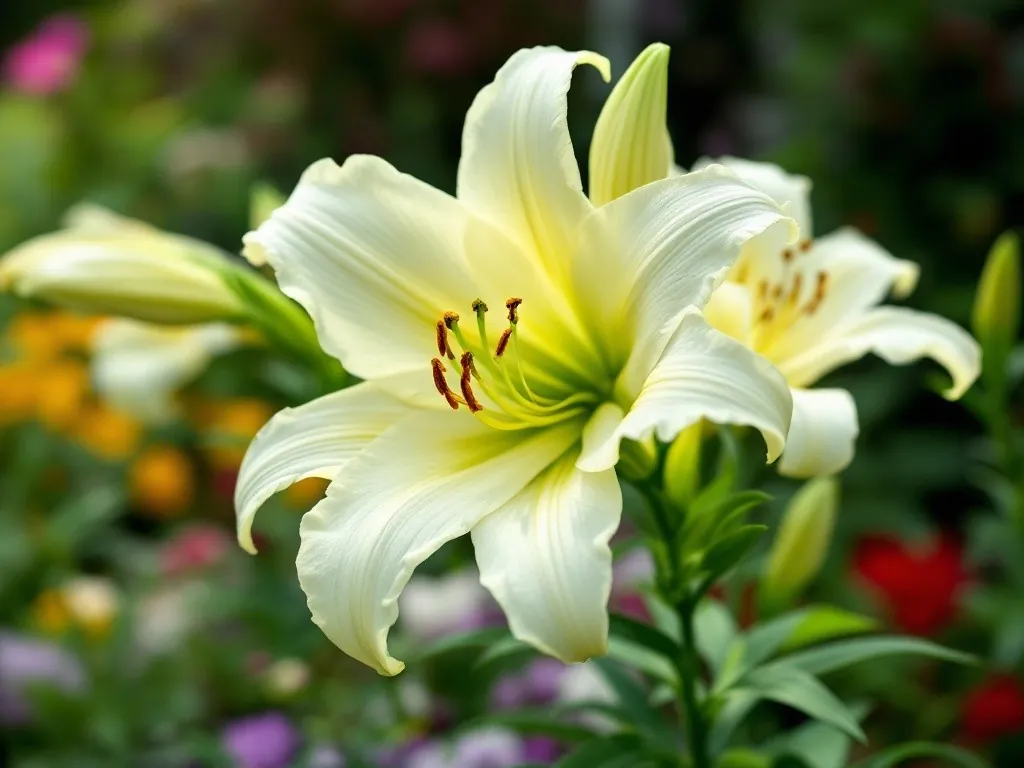
A bulbous plant with a stiff, leafy stem topped by one or several large, six-petalled flowers in trumpet, bowl or turk's-cap shapes, in a very wide range of colours.
Growing and care
Watering
Needs free-draining soil — bulbs rot in standing water. Water moderately during growth and flowering.
Fertilizing
Potassium supports sturdy stems and intense flowering.
Planting
Free-draining, fertile soil; plant at about three times the bulb's height, on a free-draining sand cushion to protect against rot.
Pruning
Remove spent flowers; leave stems and leaves until they yellow, as they nourish the bulb.
Companion plants
Good companions
They shade the soil and cool the lily's bulbs, whose 'feet' like shade, while the flowers need sun.
Bad companions
Lily bulbs rot in the waterlogged substrate required by moisture-loving plants.
The evidence level indicates whether the relationship is backed by research, observation, or gardening tradition.
Diseases and pests
Toxicity
| For whom | Level | Notes |
|---|---|---|
| Humans | Mild | — |
| Dogs | Moderate | — |
| Cats | Lethal | Lilies are deadly toxic to cats — even pollen or vase water can trigger acute kidney failure. |
History and origin
Lilies have been cultivated since antiquity — the Madonna lily (Lilium candidum) was already a symbol of purity in Minoan and Christian culture. The wealth of modern cultivars is the result of 20th-century hybrid breeding.
Uses
For perennial borders, ornamental gardens, containers, and as a cut flower. Because of its toxicity to cats, it is not recommended in households with these animals.
Trivia
- Lilies are among the plants most dangerous to cats — contact with any part of the plant or with vase water risks fatal kidney failure.
- Not everything called a 'lily' is a true lily — daylilies (Hemerocallis) or water lilies are entirely different plants.
Frequently asked questions
Are lilies dangerous to cats?
Yes, extremely — lilies of the genus Lilium are deadly toxic to cats. Even eating pollen, a leaf, or drinking vase water can trigger acute, often fatal kidney failure. They should be avoided in households with cats.
How deep should lily bulbs be planted?
Deep — about three times the bulb's height (usually 12-18 cm). Deep planting stabilises the tall stems and protects the bulbs from frost.
Why does my lily fall over?
Tall cultivars with heavy flowers may need staking. Deep planting and a site sheltered from strong wind also help.
Sources
- Plants of the World Online (POWO)Database (GBIF, POWO…)
- RHS — LiliumInstitution / botanical garden
My note
A private note for this plant — saved in your browser.