In short
- Blooms very early (March–April), before the leaves develop.
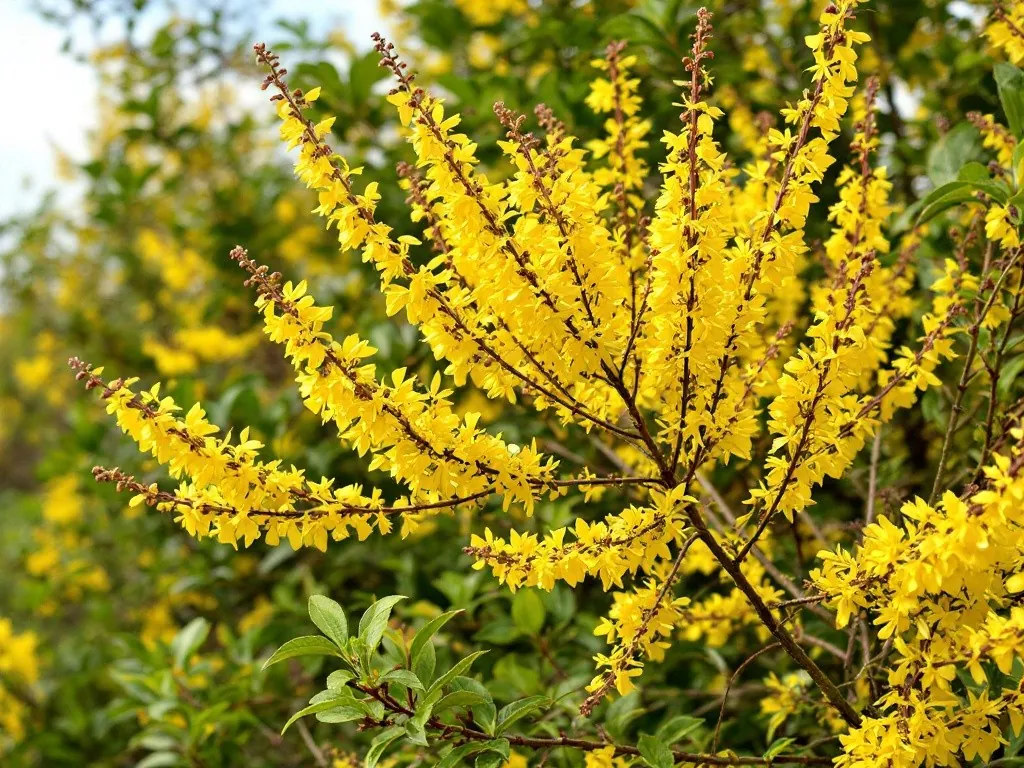
- Yellow flowers cover the entire branches — hence the name "golden rain".
- Undemanding, drought- and frost-hardy.
- Prune IMMEDIATELY after flowering — buds form on the previous year's growth.
- Easy to train into a flowering hedge.
Botanical data
- Family
- Oleaceae (Oleaceae)
- Height
- 1.5–3 m
- Width
- 1.5–3 m
- Habit
- Spreading
- Growth rate
- Fast
- Position
- Full sun, Partial shade
- Soil
- Loamy, Humus-rich, Sandy
- pH reaction
- pH 6–7.5
- Moisture
- Moderate
- Bloom
- March–April
- Hardiness
- USDA 5a–8b
- Propagation
- From cuttings, By layering
Characteristics
A spreading shrub with arching branches that become densely covered with yellow, four-petalled flowers in early spring. The lance-shaped green leaves develop only after flowering.
Growing and care
Watering
Once established, drought-tolerant and undemanding; watering is needed mainly in the first season.
Fertilizing
Undemanding — grows well even on average soils.
Planting
Tolerates almost any well-drained soil; flowers most abundantly in full sun.
Pruning
Cut out some of the oldest branches at the base each year to rejuvenate the shrub and maintain abundant flowering.
Companion plants
Good companions
Forsythia flowers early (March–April) and lilac later (May–June) — planted together they extend the flowering season of the hedge.
Bad companions
The dense, spreading forsythia shrub quickly shades plants set right at its base.
The evidence level indicates whether the relationship is backed by research, observation, or gardening tradition.
Diseases and pests
Toxicity
| For whom | Level | Notes |
|---|---|---|
| Humans | None | — |
| Dogs | None | — |
| Cats | None | — |
History and origin
Forsythia was named after William Forsyth, an 18th-century Scottish gardener. The popular hybrid form was raised in Germany in the 19th century and quickly became one of the most widely planted spring shrubs.
Uses
For gardens as a specimen plant, in groups, for informal flowering hedges, and as early-flowering branches cut for indoor arrangements.
Trivia
- Forsythia branches cut in February and placed in water bloom indoors (a technique known as forcing), announcing spring.
- Forsythia belongs to the same family as lilac and olive (the olive family).
Frequently asked questions
Why does my forsythia flower poorly?
The most common cause is pruning at the wrong time — cutting in summer, autumn or winter removes the flower buds already formed for the following year. Forsythia should be pruned only immediately after flowering. Excessive shade also reduces flowering.
When and how should forsythia be pruned?
Immediately after flowering (April–May). Each year it is worth cutting some of the oldest branches out at the base to rejuvenate the shrub — flowering is more abundant on young growth.
Can forsythia be forced to flower indoors?
Yes — branches cut in February and placed in water in a warm room will bloom after several days to a couple of weeks. It is a popular way to bring spring forward.
Sources
- Plants of the World Online (POWO)Database (GBIF, POWO…)
- RHS — ForsythiaInstitution / botanical garden
My note
A private note for this plant — saved in your browser.