In short
- Needs deeply worked, free-draining soil free of stones.
- Do not use fresh manure — it causes forked roots.
- Even moisture prevents roots from splitting.
- Growing onions nearby protects against carrot fly.
- Thinning gives the roots room to swell.
Botanical data
- Family
- Apiaceae (Apiaceae)
- Height
- 0.2–0.6 m
- Width
- 0.1–0.2 m
- Habit
- Upright
- Growth rate
- Moderate
- Position
- Full sun
- Soil
- Sandy, Humus-rich
- pH reaction
- pH 6–6.8
- Moisture
- Moderate
- Bloom
- June–July
- Hardiness
- USDA 3a–10b
- Propagation
- From seed
Characteristics
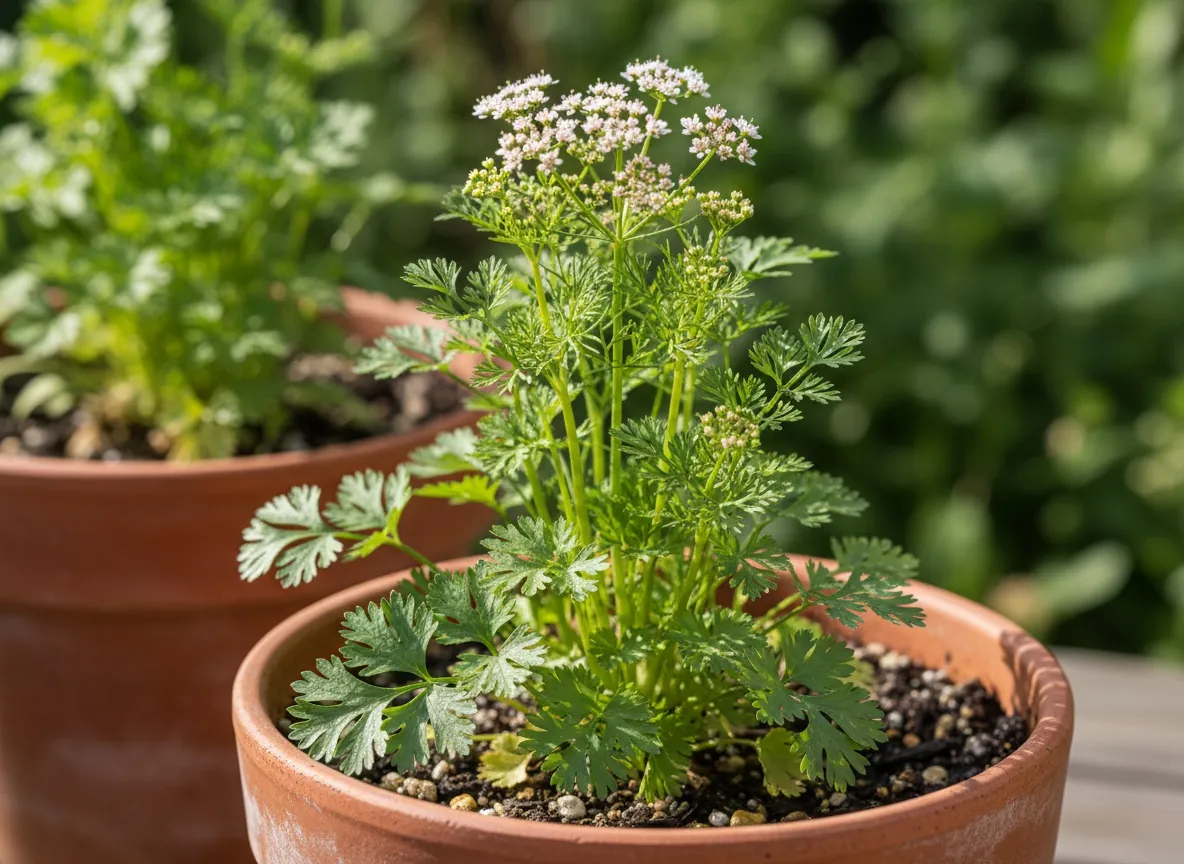
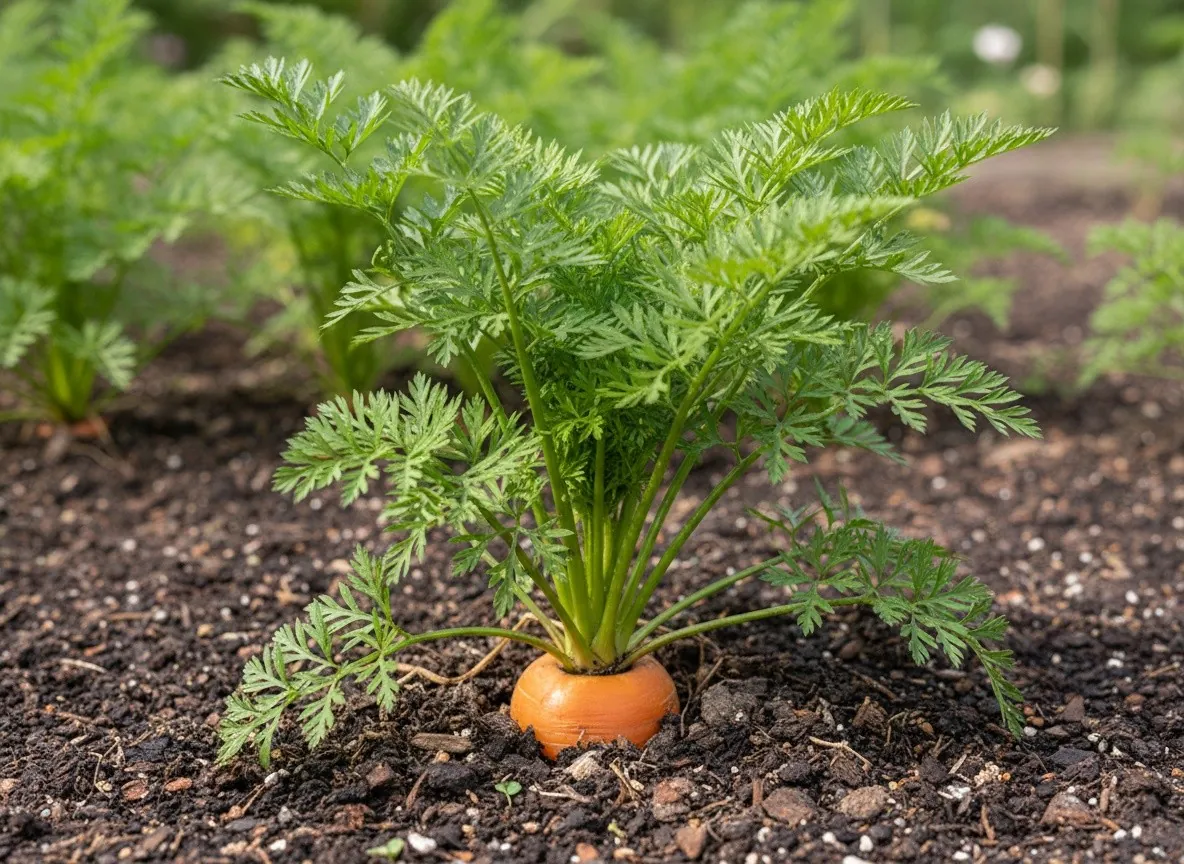
A plant with feathery, finely divided leaves and a single, spindle-shaped storage root, usually orange (yellow, white and purple cultivars also exist). In its second year it produces an umbel of white flowers.
Growing and care
Watering
Needs even moisture — irregular watering causes roots to split. Heavy watering after a dry spell bursts the carrots.
Fertilizing
Do NOT use fresh manure or excess nitrogen — it causes forked and deformed roots.
Planting
Deeply worked, free-draining soil free of stones and fresh manure; stones and compacted soil cause forked roots.
Pruning
Thin seedlings to a spacing of 5-8 cm, so the roots have room to swell.
Companion plants
Good companions
The scent of onion repels carrot fly, and the scent of carrot repels onion fly — a classic, mutually beneficial pairing.
Fast-growing radish marks the rows and loosens the soil before the carrots develop.
Bad companions
Dill belongs to the same family as carrot and can cross with it and compete with it, while also favouring shared pests.
The evidence level indicates whether the relationship is backed by research, observation, or gardening tradition.
Diseases and pests
Small (1–3 mm) soft-bodied insects, green, black or pink, feeding in clusters on young shoots and the underside of leaves. They excrete sticky honeydew.
Carrot flyA fly whose larvae tunnel through the roots of carrots (as well as parsley, celery and parsnip). Symptoms: rusty tunnels and galleries in the root, brownish-red discolouration of the foliage, a bitter taste and rotting of the roots in storage. Adults are attracted by the scent of damaged leaves.
Toxicity
| For whom | Level | Notes |
|---|---|---|
| Humans | None | — |
| Dogs | None | — |
| Cats | None | — |
History and origin
Carrot was domesticated in Central Asia — the original forms were purple and yellow. The orange carrot was selected only in the 17th century in the Netherlands, and it has dominated modern cultivation ever since.
Uses
For growing in the vegetable garden and in deep raised beds. The root is eaten raw, cooked, and used for juicing; rich in beta-carotene.
Trivia
- The orange colour of carrots comes from beta-carotene, a precursor of vitamin A.
- Wild carrot (Daucus carota) is the same species as the cultivated vegetable — the difference is the result of centuries of root selection.
Frequently asked questions
Why do carrots grow forked and crooked?
The main causes are stones and compacted soil in the root's path, fresh manure, and sowing too densely. Carrots need deeply worked, free-draining soil free of fresh organic matter.
Why do carrot roots split?
This is most often the result of irregular watering — a heavy soaking after a dry spell causes rapid growth and splits the root. The key is even moisture.
How do you protect carrots from carrot fly?
Growing onions or leeks nearby helps, as does thinning in the evening (less scent to attract the pest) and covering with horticultural fleece.
Sources
- Plants of the World Online (POWO)Database (GBIF, POWO…)
- RHS — CarrotsInstitution / botanical garden
My note
A private note for this plant — saved in your browser.