In short
- Requires full sun and a warm, sheltered wall — in shade it practically does not flower.
- Very expansive: root suckers come up several metres from the plant.
- The first flowers usually have to be waited for 3–5 years after planting.
- It flowers on the current year's shoots — prune hard in early spring.
- The sap may irritate the skin; wear gloves when pruning.
Botanical data
- Family
- Bignoniaceae (Bignoniaceae)
- Height
- 5–10 m
- Width
- 2–4 m
- Habit
- Creeping
- Growth rate
- Fast
- Position
- Full sun
- Soil
- Humus-rich, Loamy, Sandy
- pH reaction
- pH 6–7.5
- Moisture
- Moderate
- Bloom
- July–September
- Hardiness
- USDA 5a–9b
- Propagation
- From cuttings, By layering, From seed
Characteristics
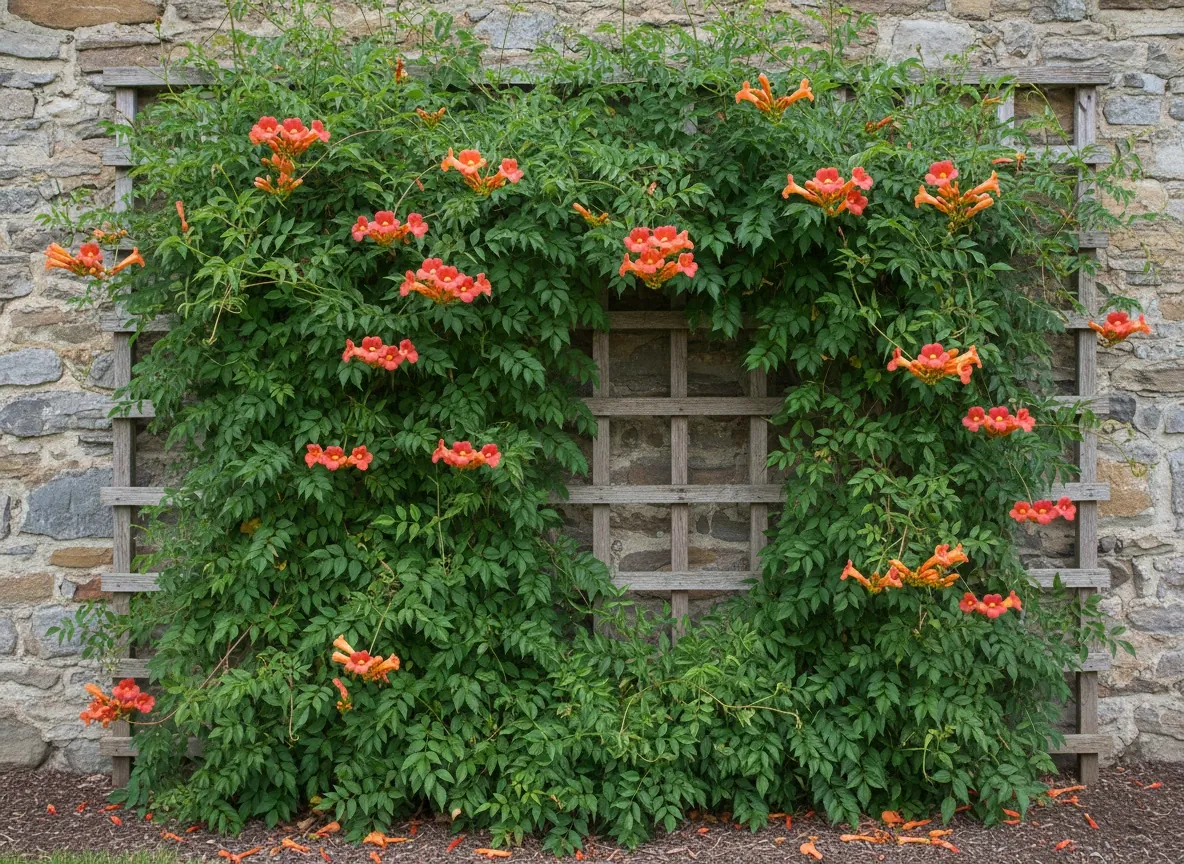
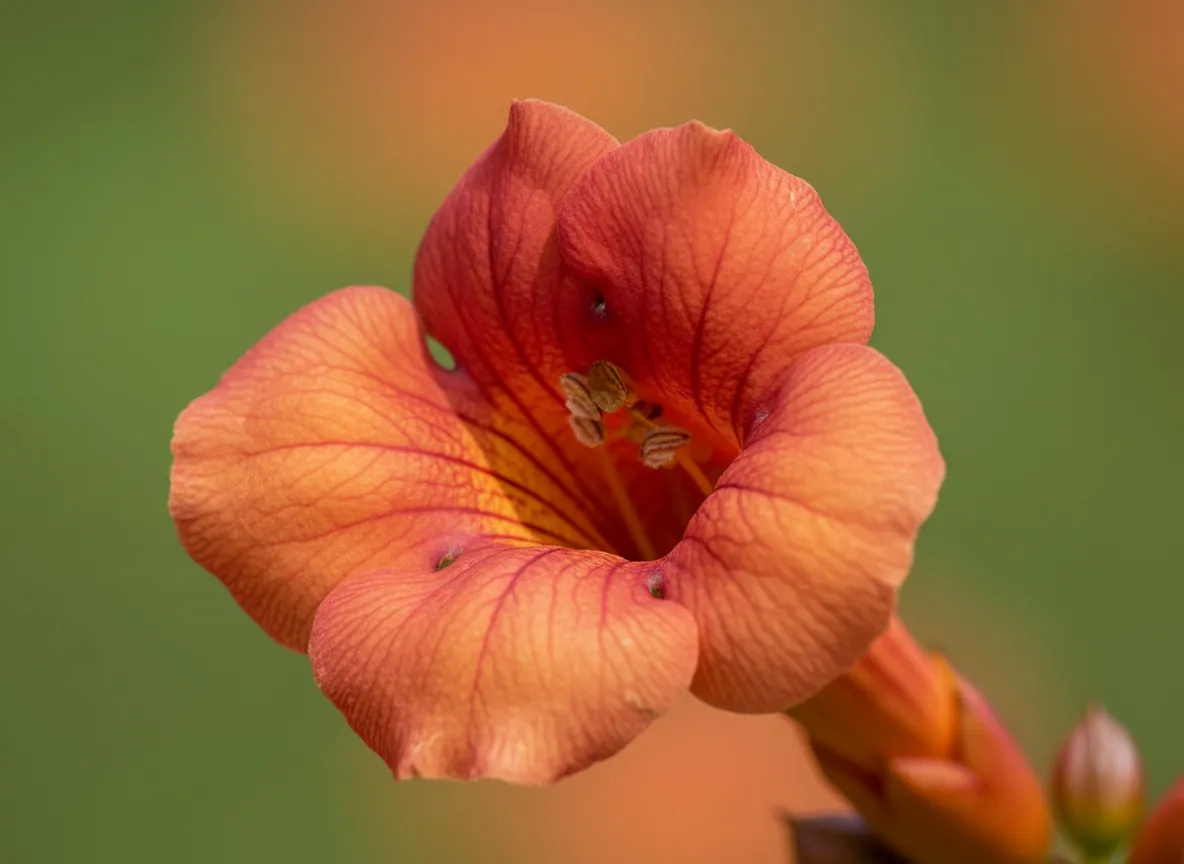
A climber growing up to 10 m, with woody shoots clinging to the support by aerial roots, aided by twining around the structure. The odd-pinnate leaves, composed of 7–11 toothed leaflets, differ markedly from the simple leaves of most climbers. The flowers, 6–9 cm long, have the shape of an elongated trumpet widening into a five-lobed disc, and are gathered into loose racemes at the tips of the current year's shoots. After flowering, long, pod-like seed capsules are set.
Growing and care
Watering
Very drought-resistant once established. Water regularly only in the first two years and during long spells of hot weather.
Fertilizing
Very carefully with nitrogen — abundantly fed, the trumpet creeper builds an enormous mass of shoots and leaves and hardly flowers at all.
Planting
A warm, sunny site sheltered from wind — best a south or west wall. It is worth digging in a root barrier straight away (e.g. edging to 40–50 cm), which will limit later root suckers.
Pruning
Prune hard and regularly: shorten the side shoots to 2–3 pairs of buds from the plant's framework. The flowers are set on the current year's shoots, so hard pruning does not take away the flowering but actually improves it.
Companion plants
Good companions
A mature trumpet creeper weighs several dozen kilograms and topples light wooden trellises — a solid support is a condition of successful cultivation.
It tolerates the same hot, dry and sunny site at the foot of the wall, and its low habit does not compete with the climber for light.
A drought-loving perennial that covers the bare base of the trumpet creeper's shoots well, without requiring the watering that the trumpet creeper does not need anyway.
Bad companions
The trumpet creeper sends out root suckers even several metres from the mother plant and moves into neighbouring crops, where it is hard to eradicate.
Trained on the same structure it gets smothered — the trumpet creeper grows far more vigorously and quickly takes over the whole support and the light.
The aerial roots grow into cracks in the plaster and under the roof covering, and the mass of shoots deforms the gutters — plant at a distance from such elements.
The evidence level indicates whether the relationship is backed by research, observation, or gardening tradition.
Toxicity
| For whom | Level | Notes |
|---|---|---|
| Humans | Mild | The sap from the shoots and leaves may cause redness and skin irritation in sensitive people — it is worth wearing gloves when pruning. The plant is not edible. |
| Dogs | Mild | Eating the leaves may cause irritation of the digestive tract and vomiting. |
| Cats | Mild | — |
History and origin
In the wild it grows in the south-east of the United States, where its flowers are one of the more important sources of nectar for hummingbirds — hence the English name hummingbird vine. It was brought to Europe in the 17th century as a garden curiosity; in the warmer regions of the continent it has become established to the point that it locally runs wild along roads and fences.
Uses
For covering strong pergolas, arbours, netting, posts and warm south-facing walls — everywhere there is room for a large, vigorously growing plant and where regular pruning will not be a problem. Because of its expansiveness it is not suited to small gardens or to the vicinity of delicate borders.
Trivia
- In the trumpet creeper's homeland its trumpet-shaped flowers are pollinated by hummingbirds — the length of the flower tube matches the length of their beak, and the vivid red is the colour these birds see best.
- In America it also bears the nickname cow itch vine, meaning roughly “the vine that makes you itch”, because contact with the sap can irritate the skin.
- The root suckers can come up through the lawn several metres from the mother plant and appear for years after the specimen has been removed.
Frequently asked questions
Why is my trumpet creeper not flowering?
The most common causes are the plant being too young (the first flowers usually appear after 3–5 years), too little sunlight, and an excess of nitrogen in feeding, which induces the plant to build shoots instead of flower buds. Hard pruning in early spring also helps, because the flowers are set on the current year's shoots.
How do you get rid of trumpet creeper suckers?
The suckers are best cut out systematically right at ground level or mown along with the lawn — the plant itself only weakens after long, consistent removal. It is most effective, however, to prevent them: when planting, dig a root barrier around the root ball to a depth of 40–50 cm.
Does the trumpet creeper damage a building wall?
It can — its aerial roots penetrate cracks in the plaster, and the heavy shoots push their way under gutters, window sills and roof coverings, forcing them apart over time. On a building it is safer to train it on a solid trellis set a few centimetres away from the facade, rather than letting it cling to the wall directly.
Sources
- Plants of the World Online (POWO)Database (GBIF, POWO…)
- Missouri Botanical Garden — Campsis radicansInstitution / botanical garden
My note
A private note for this plant — saved in your browser.