In short
- An ALIEN and INVASIVE species in Europe, including Poland — do not release it into natural waters and do not dispose of biomass there.
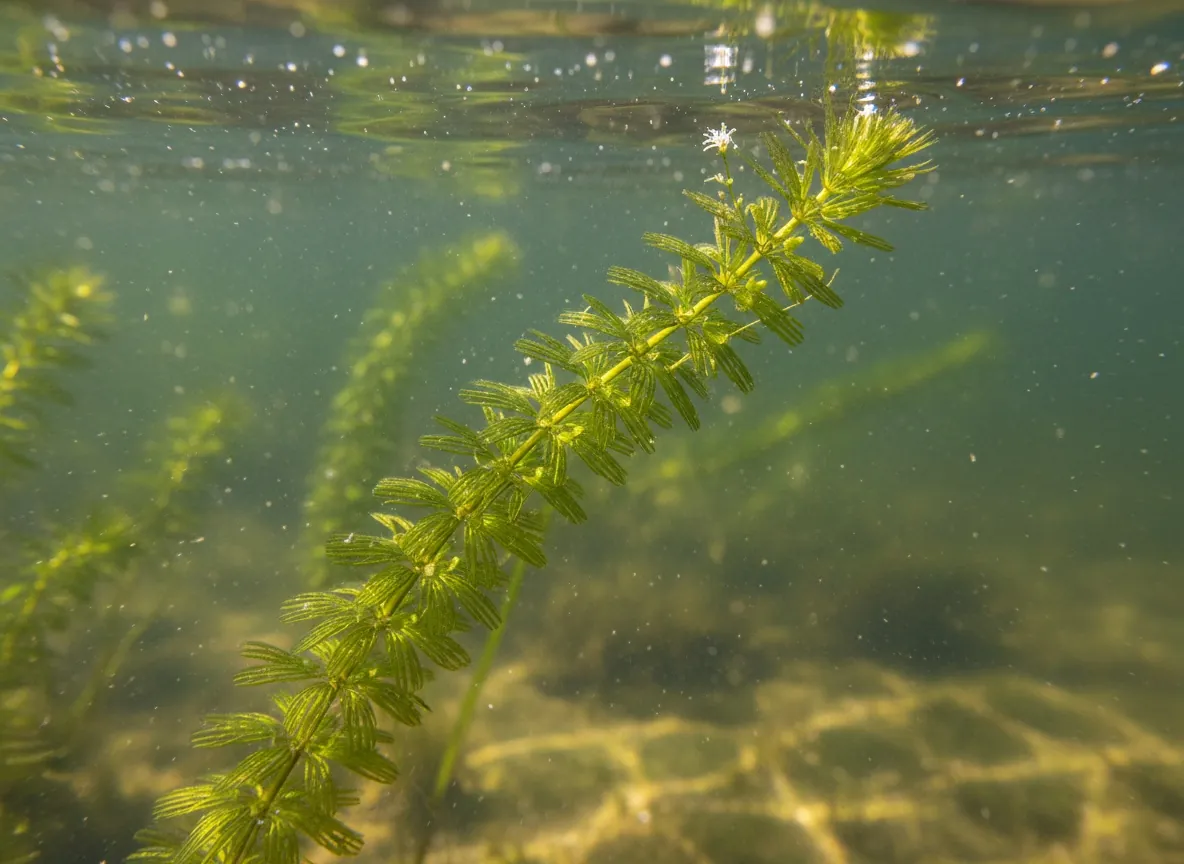
- It grows entirely under water; dark green leaves in whorls of three on a limp, flexible shoot.
- In Europe it reproduces EXCLUSIVELY by vegetative means — from every few-centimetre fragment of shoot a whole plant regrows.
- It oxygenates the water strongly and takes nutrients away from algae, which is why it is recommended for ponds — but without control it fills the entire water column.
- Very frost-hardy: it overwinters under the ice as green shoots, without turions and without a dormant period.
- In a garden pond, plant it only in a basket and remove the surplus regularly; dry the surplus and compost it.
Botanical data
- Family
- Hydrocharitaceae (Hydrocharitaceae)
- Height
- 0.2–1 m
- Width
- 0.5–2 m
- Habit
- Creeping
- Growth rate
- Fast
- Position
- Full sun, Partial shade
- Soil
- Humus-rich, Clay, Sandy
- pH reaction
- pH 6–8.5
- Moisture
- Wet
- Bloom
- June–August
- Hardiness
- USDA 3a–10a
- Propagation
- From cuttings, By division
Characteristics
The plant grows entirely under water, anchored in the bottom by thin, whitish adventitious roots — these, however, serve mainly to hold on to the substrate, because Canadian waterweed takes up nutrients over the whole surface of its shoot straight from the open water. The shoot is limp, flexible, strongly branched, typically some tens of centimetres to a metre long, though in deep, fertile water it can stretch to 2–3 m in order to reach the light. The leaves are small (6–15 mm), oblong, dark green, translucent, set in whorls of three — this is the simplest diagnostic feature in the field. The flowers are inconspicuous: small, whitish to pinkish, with three petals, carried to the surface on a long, thread-like tube so that pollination can take place at the boundary of water and air. In Europe, however, this is of purely theoretical significance — the species is dioecious, and on our continent almost only female plants occur, so seeds practically never form. The entire European population reproduces by fragmentation: the shoot breaks, and every fragment with a node puts out roots and founds a new plant. It overwinters as green shoots under the ice, without turions and without a distinct dormant period, which is why it starts into growth earlier in spring than most aquatic plants.
Growing and care
Watering
The plant grows completely submerged and is not watered at all — it takes up nutrients directly from the water over the whole surface of its shoot, and its roots serve it mainly for anchorage. Taken out of the water it withers within a dozen or so minutes. It tolerates a very wide range of conditions: from cool to warm water, from fertile to poor, and it survives the winter under the ice in the form of green shoots.
Planting
A bunch of shoots is weighted with lead tape and pushed into the substrate, or simply thrown into the water — it will root by itself. In a garden pond plant it ONLY in a basket, so that it can later be taken out whole. It grows at depths from some tens of centimetres to several metres, in standing or very slow-flowing water.
Pruning
Pull out surplus shoots with a rake or a net once they begin to fill the water column — in fertile water that means several times a season. Leave the biomass you have fished out on the bank for a few hours so that small aquatic animals can return to the water body, and then be sure to dry and compost it.
Companion plants
Good companions
They occupy different storeys of the water body — the waterweed the water column, the water lilies the surface — and at the same time they complement one another functionally: the waterweed oxygenates the water and takes nutrients away from algae, while the water lily leaves shade the surface, curbing its excessive growth.
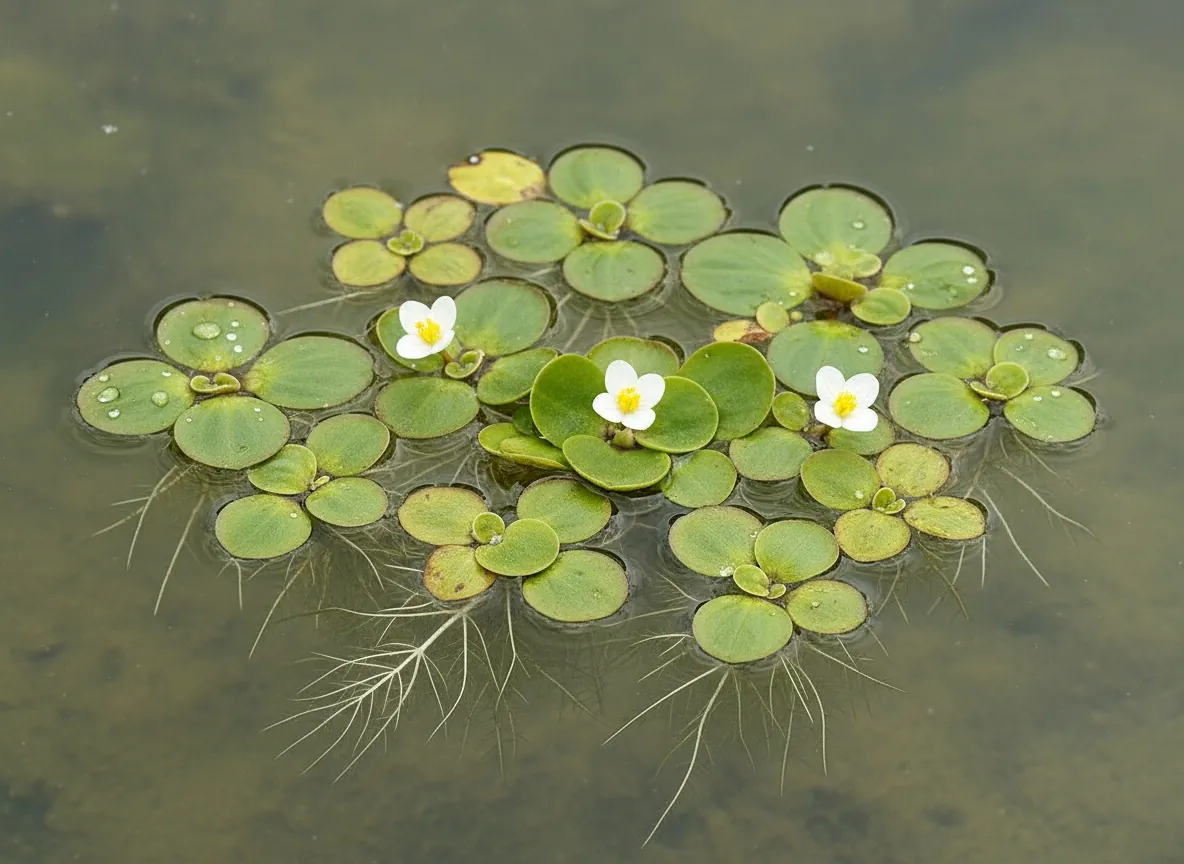
The waterweed oxygenates the water column and competes with algae for nutrients, keeping the water clear, while the floating frogbit shades the surface and thereby dims the waterweed — an arrangement in which both plants limit one another instead of getting out of hand.
Bad companions
These are the most frequent victims of Canadian waterweed: it occupies exactly the same niche — the water column — but grows far faster and fills the entire volume of the water body, cutting off light from the native submerged species. It is in precisely this way that the species impoverishes the natural vegetation of European waters.
Lotus requires warm, fertile and still water and an open bottom zone for its rhizome; the dense mat of waterweed fills the water column, hampers its growth and takes nutrients out of the water.
The evidence level indicates whether the relationship is backed by research, observation, or gardening tradition.
Toxicity
| For whom | Level | Notes |
|---|---|---|
| Humans | None | The plant is not toxic. Its problem is ecological, not toxicological: it is an alien and invasive species in Europe, which must not be released into natural waters. |
| Dogs | None | — |
| Cats | None | — |
History and origin
The history of Canadian waterweed in Europe is one of the earliest and best documented cases of a biological invasion. The plant appeared in the British Isles in the 1830s, probably with ships' ballast or by way of botanical gardens, and within two decades it had taken over the canals, rivers and lakes of England so thoroughly that it hampered navigation, rowing and fishing. The Victorian press wrote about it with alarm, and the Germans gave it the name that stuck to it for good: Wasserpest — water plague. It reached Poland in the 1860s and today is common throughout the country. After this violent expansion, however, came something nobody had expected: in many water bodies the populations of Canadian waterweed thinned out by themselves after several decades and stabilised at a far lower level — this phenomenon, described in the literature as the “wave effect” typical of many invasions, still has no full explanation. That does not change its status: the species remains alien and invasive, and its lasting consequence is the impoverishment of the native submerged vegetation in many European waters. In parallel, the plant made a career in an entirely different place — in school biology laboratories, where for generations it has served to demonstrate photosynthesis: under strong light, bubbles of oxygen can be seen with the naked eye emerging from a cut shoot.
Uses
The plant is sometimes recommended for garden ponds as a cheap and effective “oxygenating plant” — it does indeed oxygenate the water strongly and take nutrients away from algae, so in a young water body it quickly improves clarity. One must know, however, what one is letting oneself in for: this is an alien and invasive species that in fertile water can fill the entire water column in a single season and needs to be raked out several times a year. If the water body is naturalistic in character or connected to a watercourse, a far better choice is the native rigid hornwort, which performs exactly the same function without the ecological risk. If you reach for Canadian waterweed nevertheless, three rules apply: plant it in a basket so that it can be taken out whole; remove the surplus regularly; and never — under any circumstances — throw biomass or aquarium water into a ditch, a stream or a lake.
Trivia
- Practically every Canadian waterweed growing in Europe is a female plant. The species is dioecious, and almost only specimens of one sex reached our continent, so pollination and seeds are an extremely rare occurrence here. This means that the entire European population — from Ireland to the Urals, after nearly two hundred years of expansion — is in fact one enormous clone, propagated solely by breaking shoots.
- It is the same ability to regrow from a fragment that makes it invasive that has determined its career: a few-centimetre fragment of shoot attached to a boat's hull, to a fishing rod or to a bird's feather is enough to found a population in a new water body. That is why the biomass taken out of a pond must never be thrown into water — it must be dried and composted.
- Canadian waterweed has for generations been the standard plant in school experiments on photosynthesis: under strong light, bubbles of oxygen visible to the naked eye emerge from a cut shoot, and they can simply be counted. It is hard to imagine a simpler way of measuring the rate of photosynthesis in a classroom.
Frequently asked questions
Can Canadian waterweed be legally planted in a garden pond?
Yes — unlike water hyacinth, Canadian waterweed is not on the EU list of banned species, and it may be bought and planted in one's own water body. It remains, however, an alien and invasive species in Europe, so an iron rule applies: nothing from that water body may reach natural waters. Do not throw cut shoots into a ditch or a stream, do not empty an aquarium there, and do not move the plant to water bodies outside your own garden. In a naturalistic pond, consider the native rigid hornwort instead.
Canadian waterweed has overgrown my whole pool — how do I get rid of it?
The only effective method is patiently removing the biomass with a rake or a net, repeated throughout the season and preferably over several years, until the plant's reserves are exhausted. Thorough fishing-out is crucial: every fragment of shoot left behind regrows into a new plant, so a superficial thinning of the colony only propagates it. It is also worth reducing the fertility of the water — less nitrogen and phosphorus (do not fertilise the water body, do not overfeed the fish) means slower growth. Leave the mass you have fished out on the bank for a few hours so that aquatic animals can return to the water, and then dry and compost it.
Why does my Canadian waterweed never set seeds?
Because it is almost certainly a female plant — and there is no male one anywhere nearby. The species is dioecious, and almost only female specimens reached Europe, so pollination happens here extremely rarely. The entire European population reproduces vegetatively: the shoots break, and every fragment with a node puts out roots and founds a new plant. That is why Canadian waterweed spreads so efficiently despite the absence of seeds — and why its clippings must not be thrown into natural waters.
Sources
- Plants of the World Online (POWO) — Elodea canadensisDatabase (GBIF, POWO…)
- CABI Compendium — Elodea canadensis (Canadian pondweed)Database (GBIF, POWO…)
My note
A private note for this plant — saved in your browser.