In short
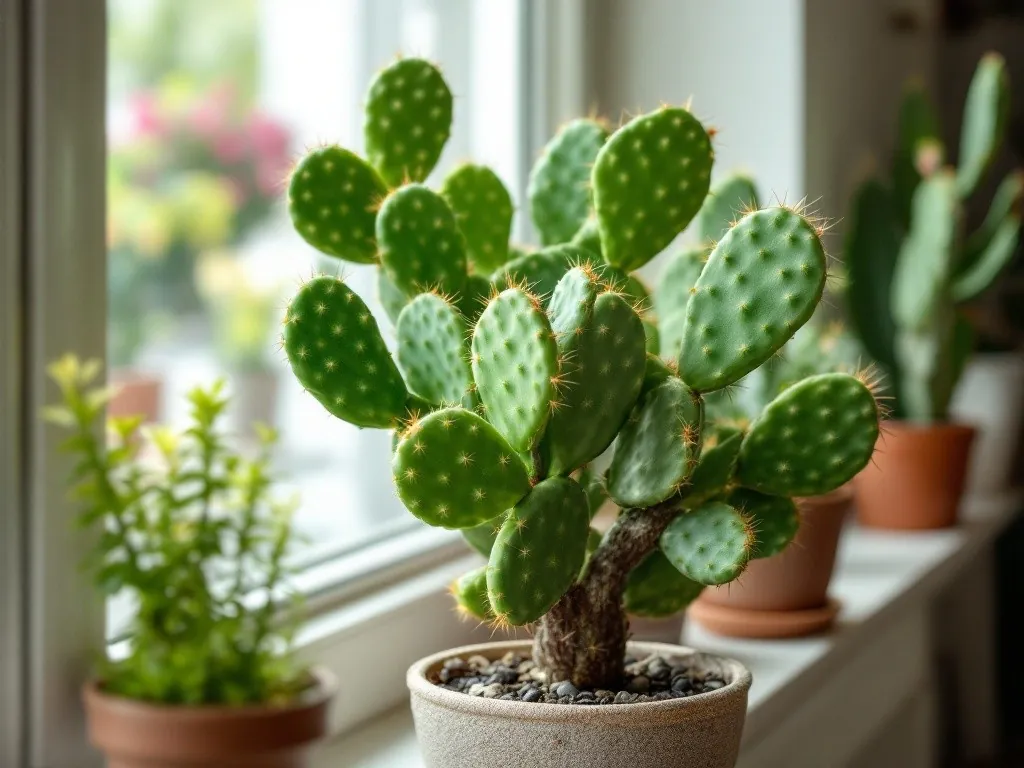
- Flat, oval segments (cladodes) covered in spines and fine, barbed glochids.
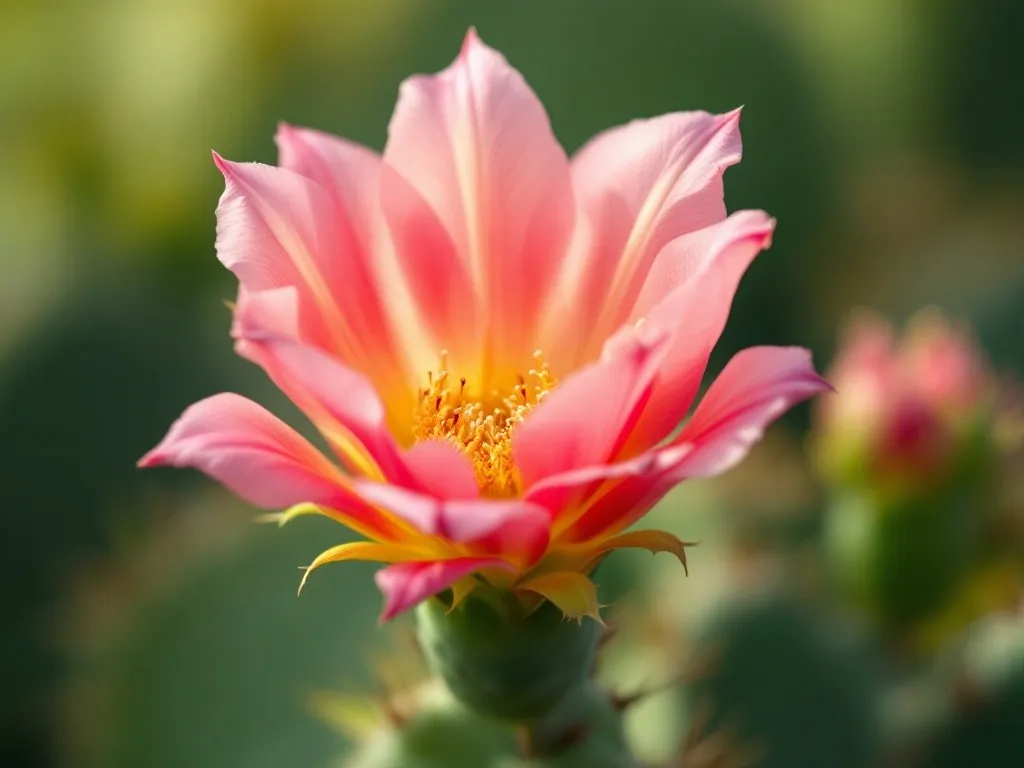
- Yellow flowers and edible fruits (prickly pear) in summer and autumn.
- Not frost-hardy in Poland — it must be overwintered indoors or in a greenhouse.
- In its native climate it grows several metres tall into a tree-like form; in a pot usually 0.3–1.5 m.
- Very drought-tolerant, requiring full sun and a free-draining substrate.
- The glochids embed easily in the skin — care requires gloves.
Botanical data
- Family
- Cactaceae (Cactaceae)
- Height
- 0.3–1.5 m
- Width
- 0.3–1.2 m
- Habit
- Spreading
- Growth rate
- Moderate
- Position
- Full sun
- Soil
- Sandy
- pH reaction
- pH 6–8
- Moisture
- Dry
- Bloom
- May–July
- Hardiness
- USDA 8b–11a
- Propagation
- From cuttings, From seed
Characteristics
A cactus that is leafless in the typical botanical sense, built from flat, oval segments (cladodes) that act as leaves and shoots and are joined in a chain. The segments are covered with spines and with tufts of fine, barbed glochids that detach at the slightest touch. In spring and summer, large yellow flowers appear along the edges of the segments, developing into pear-shaped, colourful fruits.
Growing and care
Watering
The segments (cladodes) store large reserves of water. Water generously but infrequently, only after the substrate has dried out completely — in winter, when the plant overwinters in the cool, reduce watering to a minimum or stop it altogether.
Fertilizing
Small doses of a low-nitrogen, potassium-rich fertiliser — excess nitrogen leads to soft, rot-prone segments.
Planting
A very free-draining mineral cactus substrate (with added grit, perlite or sand); a pot with a drainage hole.
Pruning
Cut off whole segments (cladodes) at the base with a sharp, clean knife, always wearing protective gloves and preferably with an extra aid (e.g. tongs) — the fine, barbed glochids embed easily in the skin and are hard to remove.
Companion plants
Good companions
Identical requirements — full sun, a very free-draining substrate, infrequent watering; a natural companion in cactus-and-succulent arrangements.
Bad companions
A shared, regularly watered substrate in shade leads to rot of the roots and segments of the prickly pear, which requires drought and full sun.
The evidence level indicates whether the relationship is backed by research, observation, or gardening tradition.
Diseases and pests
Insects covered in a white, cottony, waxy coating, gathering in leaf axils, at the base of shoots and on the underside of leaf blades. They look like tufts of cotton wool. They suck sap, weaken the plant and excrete sticky honeydew, on which black sooty mould develops. A common pest of houseplants and succulents.
Armoured and soft scale insectsImmobile, brown or yellowish shields (1–4 mm) attached to stems and the underside of leaves, especially along the veins. Easily mistaken for growths on the plant. They suck sap, causing yellowing and weakening, and excrete sticky honeydew. Common on figs, orchids and plants with tough leaves.
Toxicity
| For whom | Level | Notes |
|---|---|---|
| Humans | Mild | The plants are not poisonous, but the spines and the fine, barbed glochids covering the segments embed easily in the skin, causing long-lasting irritation and itching. Always wear gloves when handling. |
| Dogs | Mild | Contact with the spines and glochids can irritate the muzzle and paws; eating the fruits in small amounts is generally safe, but the spines on the fruit skin must be removed. |
| Cats | Mild | — |
History and origin
The prickly pear was cultivated and selected by the pre-Columbian civilisations of Mesoamerica (including the Aztecs) as a useful plant — a source of fruit, fodder and the cochineal dye from the insects feeding on it. After the Spanish conquest the species quickly spread throughout the Mediterranean basin, North Africa and other warm regions of the world, where in many places it became naturalised and part of the local cuisine and landscape.
Uses
As a potted plant for sunny terraces and balconies in summer, with mandatory overwintering in a cool, bright room (e.g. an unheated greenhouse) in winter. In warmer countries it is also grown as a useful plant (fruits, edible young segments) and as an impenetrable hedge.
Trivia
- The fruits of the prickly pear, known as cactus figs or prickly pears, are widely eaten raw, in juices and jams in Mexican, Mediterranean and North African cuisine — they have a sweet, slightly tart flavour reminiscent of watermelon with a note of pear.
- Young segments (nopal), once the spines are removed, are a popular vegetable in Mexican cuisine, prepared like green beans.
- In the wild and in warm climates the plant can eventually develop a woody trunk and take on a tree-like form several metres tall — in the Polish climate, where it is grown only in a pot, it remains much smaller.
Frequently asked questions
Can prickly pear be grown outdoors in the ground in Poland?
Not permanently — the species is not frost-hardy in the Polish climate (it naturally grows in zones 8b–11a) and in winter must be moved to a bright, cool, frost-free room. In Poland it is grown exclusively as a potted or greenhouse plant.
How do you handle prickly pear safely when repotting?
Always with thick gloves — besides the visible spines, the segments are covered with fine, barbed glochids that are almost invisible, detach easily on contact and embed in the skin, causing long-lasting itching. To move larger segments, it helps to use tongs or a rolled-up newspaper.
Are the fruits of the prickly pear edible?
Yes, the fruits (prickly pears) are widely eaten raw, in juices and jams, especially in Mexican and Mediterranean cuisine. Before eating, however, the spines and glochids must be thoroughly removed from the skin, preferably wearing gloves.
Sources
- Plants of the World Online (POWO)Database (GBIF, POWO…)
- RHS — Opuntia ficus-indicaInstitution / botanical garden
My note
A private note for this plant — saved in your browser.