In short
- From its old generic name (Spiraea) comes the name of ASPIRIN — it was in this plant that salicylic compounds were first found.
- Native to Poland and common on damp meadows, in riverside tall-herb communities and in alder carrs.
- Position: permanently moist or wet, fertile soil; sun or partial shade. It does not tolerate drought at all.
- It flowers from June to August with frothy, cream-white umbels with a pronounced almond scent.
- The flowers give NO nectar — insects come for the pollen, so despite abundant flowering it is poor honey forage.
- Very frost-hardy (USDA 3), long-lived and practically maintenance-free; it is not toxic, but it does contain salicylates.
Botanical data
- Family
- Rosaceae (Rosaceae)
- Height
- 0.8–1.5 m
- Width
- 0.4–0.8 m
- Habit
- Upright
- Growth rate
- Fast
- Position
- Full sun, Partial shade
- Soil
- Loamy, Clay, Peaty, Humus-rich
- pH reaction
- pH 5.5–7.5
- Moisture
- Wet, Moist
- Bloom
- June–August
- Hardiness
- USDA 3a–9a
- Propagation
- By division, From seed
Characteristics
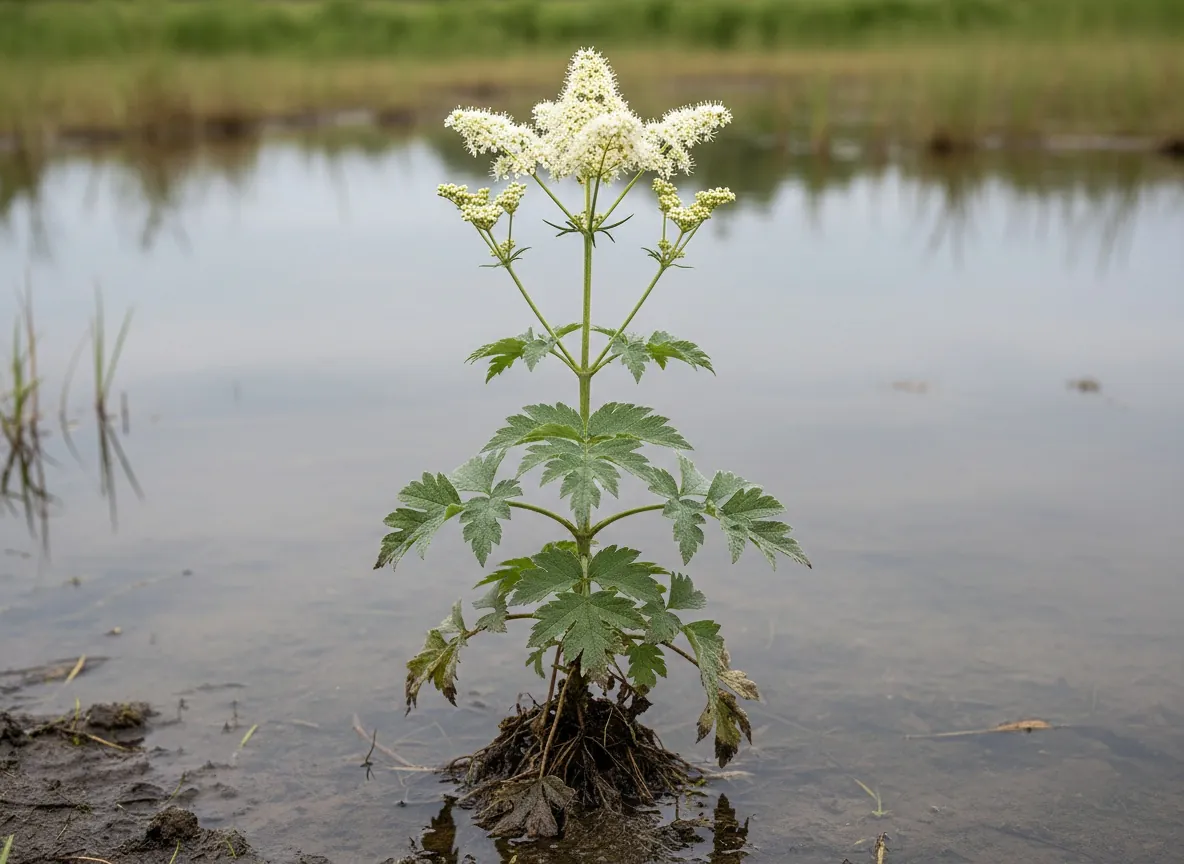
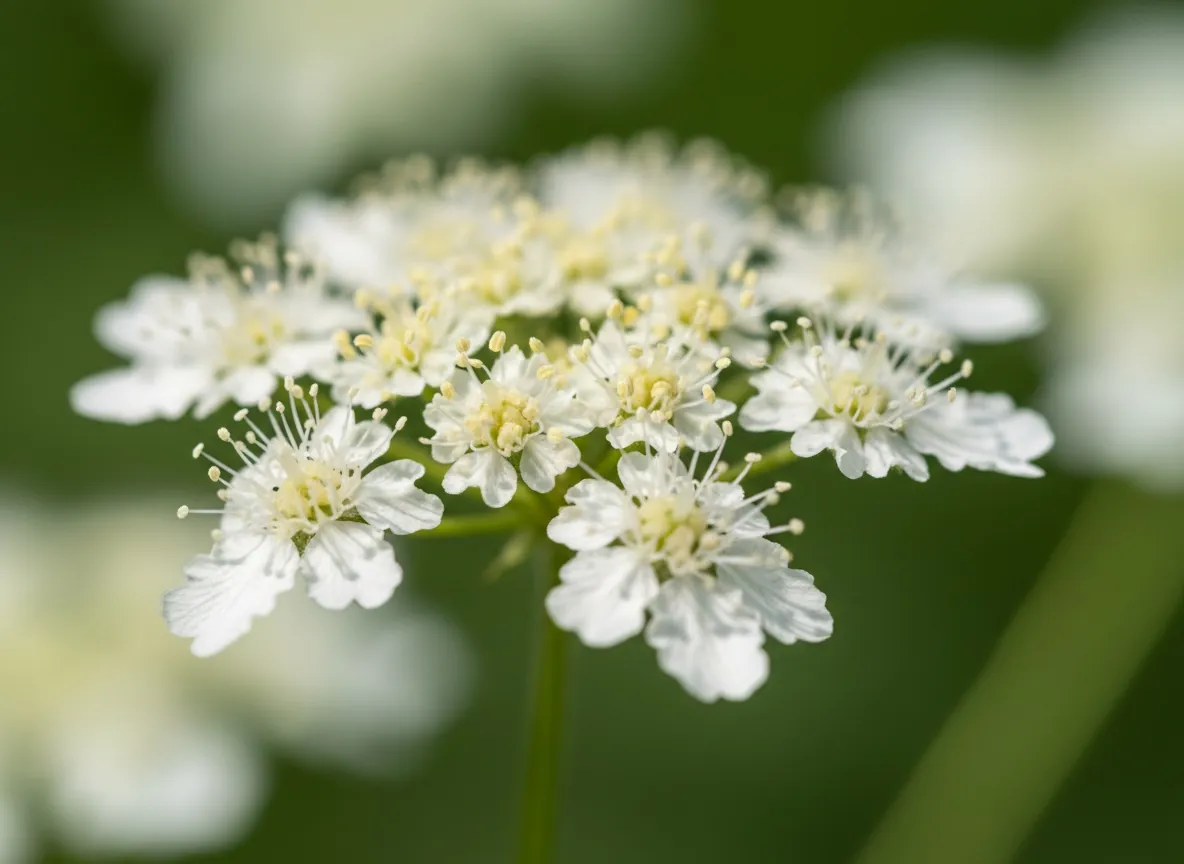
A perennial growing from a short, woody rhizome, forming a dense clump of erect, reddish shoots 80–150 cm tall. The leaves are its first diagnostic feature: large, pinnately compound, with 2–5 pairs of toothed leaflets, between which smaller intermediate leaflets are wedged, and covered beneath with a silvery-white felt, which makes the whole clump “turn grey” on a windy day. The shape of the leaflets resembles elm leaves — hence both the Polish generic name and the epithet ulmaria. The inflorescence is a broad, branched, frothy corymb made up of hundreds of small, cream-white flowers with numerous protruding stamens, which give it its characteristic fluffiness. The scent is intense, almond-and-honey-like, perceptible from several metres away on a warm, damp day; the crushed leaves smell entirely different — cool and slightly medicinal, like salicylic ointment. The flowers, however, have no nectar: they attract insects solely by scent and abundant pollen, which is why, despite its abundant flowering, meadowsweet is not a nectar plant in the strict sense. After flowering it sets small, spirally twisted fruitlets.
Growing and care
Watering
Moisture is an indispensable condition for meadowsweet — it is the most water-loving of the popular garden perennials. It tolerates permanent wetness and periodic flooding of the bank, but it reacts to drought instantly: the leaf margins brown and dry out, and the plant ends its season prematurely. In partial shade it needs markedly less water than in full sun.
Fertilizing
In fertile, moist soil, fertilising is unnecessary. A handful of compost in spring is enough and helps the soil hold moisture. Near a garden pond it is better not to use mineral fertilisers, because they wash into the water and favour algae.
Planting
Permanently moist, fertile and humus-rich soil — it may be heavy and clayey. The damp bank of a pond, the bottom of a rain garden and places where water collects work excellently. In an ordinary bed, mix the substrate generously with compost and mulch it, otherwise the plant will suffer in every drought. A position in sun or partial shade — in hot, dry sun the leaves scorch.
Pruning
Cut off spent inflorescences if we do not want self-seeding — the plant seeds itself quite readily on damp substrate. If the leaves are ugly or infected with mildew after flowering, the whole clump can be cut down low over the ground: given enough water it will come back with a fresh, healthy rosette in the same season.
Companion plants
Good companions
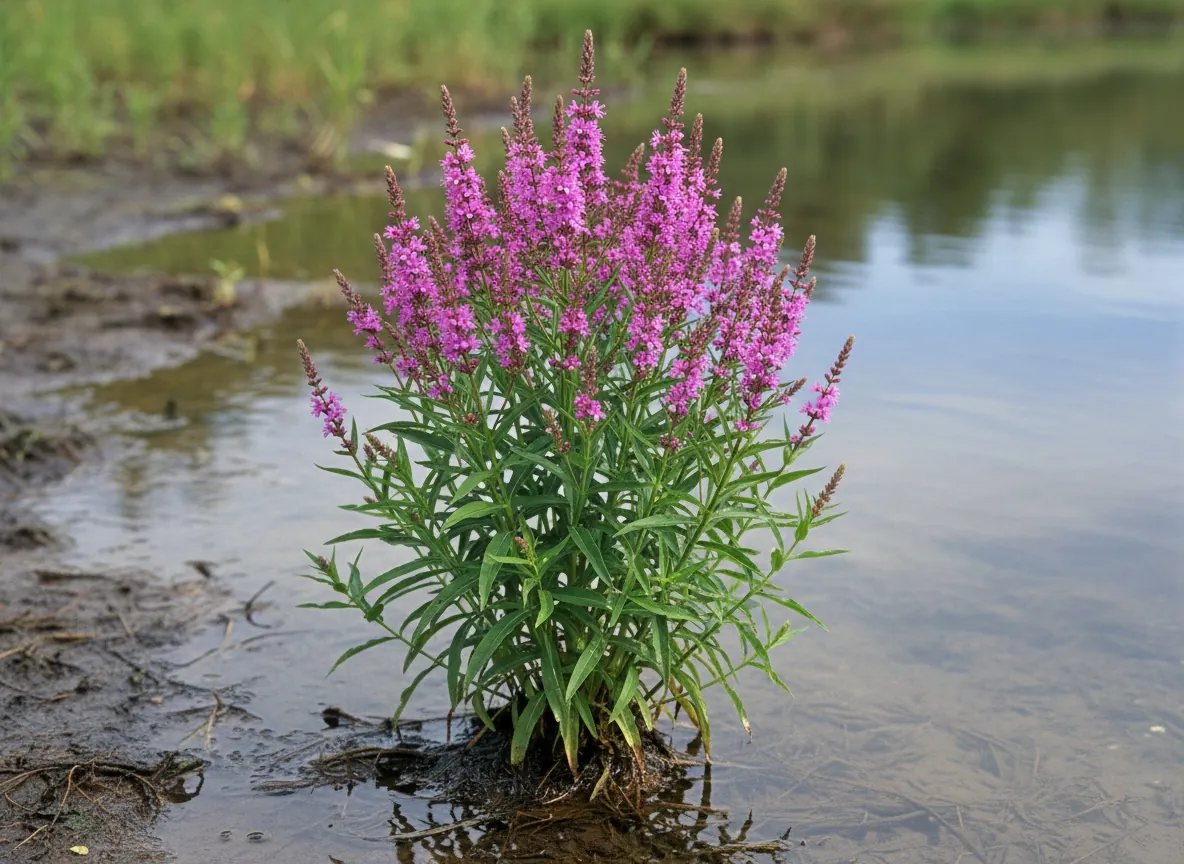
A classic duet of the damp meadow, growing side by side in the wild — the cream, frothy umbels of meadowsweet and the vertical, pink spires of purple loosestrife flower at the same time and contrast beautifully in shape and colour.
The same water requirements and the same damp bank zone, but different flowering times and a completely different texture — the stiff, sword-shaped leaves of the flag give a structure that the soft, frothy meadowsweet cannot provide.
A close relative from the same family with almost identical requirements (moisture, humus, partial shade) and similar, feathery inflorescences — together they form a coherent, soft bed for a shady, damp corner, only at different heights and in different colours.
Bad companions
Exactly opposite requirements: lavender needs dry, well-drained and calcareous soil in full sun, and meadowsweet a permanently wet, fertile substrate. They cannot be reconciled in one position — one of them will always die.
A succulent storing water in its leaves, adapted to dry, well-drained positions — in the permanently wet soil of meadowsweet it rots in the first season.
The evidence level indicates whether the relationship is backed by research, observation, or gardening tradition.
Toxicity
| For whom | Level | Notes |
|---|---|---|
| Humans | None | The plant is not toxic and has been used in herbal medicine for centuries. It does, however, contain salicylates — compounds related to aspirin — so people allergic to acetylsalicylic acid, suffering from aspirin-induced asthma, taking anticoagulants, and children should avoid infusions of the herb. It is the same caution that is applied towards aspirin. |
| Dogs | Mild | Eating larger quantities of the herb may irritate the digestive tract because of the salicylate content. |
| Cats | Mild | Cats metabolise salicylates very poorly, which is why eating larger quantities of the herb is potentially more of a burden for them than for dogs. In practice they do not eat the plant, but they should not be given infusions or preparations of meadowsweet. |
| Horses | None | — |
History and origin
Meadowsweet is one of those plants that changed medicine. In 1835 the Swiss apothecary Johann Pagenstecher distilled from its flowers the aromatic salicylaldehyde, from which salicylic acid was soon obtained — an effective, but brutally stomach-irritating painkiller and antipyretic. The problem was solved only at the end of the century: in 1897, in the laboratories of the Bayer company, its milder, acetylated derivative was synthesised. The new drug had to be given a name somehow — and they reached for the plant with which it had all begun. Meadowsweet then bore the name Spiraea ulmaria, so from the “A” of acetyl, the “spir” of Spiraea and the ending “-in”, ASPIRIN was created, registered in 1899 and to this day one of the most widely used medicines in the world. The botanical irony is that soon afterwards the plant was reclassified into the genus Filipendula — so the name of the most famous drug on Earth commemorates a genus to which its patron no longer belongs. Much earlier, meadowsweet had a different career. In medieval England it was called meadwort and was added to mead and beer for aroma — it is from this, and not from the meadow, that the English name meadowsweet comes. It was also a favourite herb for strewing the floors of chambers: trodden underfoot it gave off a scent that was meant to mask odours and repel insects, and according to the chronicler John Gerard, Queen Elizabeth I valued it especially. In Polish folk herbalism the flower and the herb were used for fever, colds and rheumatic pains — that is, as it turned out three hundred years later, quite accurately.
Uses
An excellent perennial for damp and wet places that cannot be used in any other way: the banks of garden ponds and streams, rain gardens, hollows where water collects, and damp margins of tree plantings. The frothy, cream umbels give a soft, naturalistic effect and contrast beautifully with the vertical spires of purple loosestrife or the sword-shaped leaves of yellow flag — this is the classic set of the native damp meadow transferred to the garden. The scent is an additional argument for planting it by a path or a seat. The flowers are gathered for infusions and for flavouring drinks, with the same caution as towards aspirin. Ornamental cultivars with yellow leaves ('Aurea') and with cream-margined leaves ('Variegata') are available in the trade — both require partial shade, because in full sun they scorch at the edges. The only real condition for success is water: in dry soil meadowsweet has nothing to look for.
Trivia
- The name of ASPIRIN comes directly from this plant: the “A” of acetyl, the “spir” of Spiraea ulmaria — the old name of meadowsweet — and the ending “-in”. It was in its flowers that the Swiss apothecary Johann Pagenstecher found, in 1835, the first salicylic compounds, from which the whole history of the drug began. The botanical joke is that the species was long ago moved to the genus Filipendula, so the most famous drug in the world bears the name of a genus to which its patron plant no longer belongs.
- The plant smells of two entirely different scents at once: the flowers sweetly, of almonds and honey, and the crushed leaves coolly and medicinally, like salicylic ointment. Different compounds are responsible for each of them, and that is why it was formerly used both for flavouring mead and as a medicine.
- Although it flowers abundantly and draws in swarms of insects, meadowsweet has not a drop of nectar in its flowers — it lures solely with scent and pollen. For bees it is therefore a source of protein, but not of honey; anyone planting it with honey forage in mind will be disappointed.
Frequently asked questions
Is it true that the name of aspirin comes from meadowsweet?
Yes, literally. Meadowsweet formerly bore the name Spiraea ulmaria, and it was in its flowers that the first salicylic compounds were found in 1835. When in 1897 the Bayer company synthesised their milder, acetylated derivative, the name was formed from the “A” of acetyl, the “spir” of Spiraea and the ending “-in” — thus ASPIRIN came into being. The plant was reclassified into the genus Filipendula soon afterwards, so today the drug's name commemorates a genus to which its patron no longer belongs. Meadowsweet itself does indeed contain salicylates, which is why it acts against fever and pain — folk medicine hit the mark very accurately here.
Can meadowsweet be used instead of aspirin?
Infusions of the flowers and herb have been used for centuries in herbal medicine for fever, colds and rheumatic pains, and the plant is not toxic — but it is not a substitute for a medicine with a controlled dose. The same caution applies as towards aspirin: infusions should be avoided by people allergic to acetylsalicylic acid, suffering from aspirin-induced asthma, taking anticoagulants, and by pregnant women and children. Do not gather the raw material from roadside ditches or from near fields, because the plant accumulates pollutants, and in case of doubt consult a doctor or pharmacist.
Is meadowsweet suitable for an ordinary bed, away from water?
Only if you provide it with constant moisture — it is the most water-loving of the popular garden perennials and in dry soil it simply has nothing to look for. In an average, well-drained bed the edges of its leaves will brown at the first July drought and it will end the season prematurely. If you want it away from the edge of a water body, choose a spot in partial shade, mix the soil generously with compost, mulch, and reckon with watering. It is much easier to plant it where the water collects by itself: in a rain garden, in a hollow in the ground or by a downpipe.
Sources
- Plants of the World Online (POWO) — Filipendula ulmariaDatabase (GBIF, POWO…)
- RHS — Filipendula ulmariaInstitution / botanical garden
My note
A private note for this plant — saved in your browser.