In short
- Climbs by itself with clinging roots — it needs no trellis or support.
- Flowers in shade and on a north wall, where most climbers fail.
- For the first 2–3 years it hardly grows at all, then it speeds up sharply.
- Requires constantly moist, humus-rich soil — it tolerates drying out poorly.
- Prune only after flowering; pruning in spring destroys the flower buds.
Botanical data
- Family
- Hydrangeaceae (Hydrangeaceae)
- Height
- 6–15 m
- Width
- 2–5 m
- Habit
- Creeping
- Growth rate
- Moderate
- Position
- Partial shade, Shade
- Soil
- Humus-rich, Loamy
- pH reaction
- pH 5.5–7
- Moisture
- Moderate, Moist
- Bloom
- June–July
- Hardiness
- USDA 4a–8b
- Propagation
- From cuttings, By layering
Characteristics
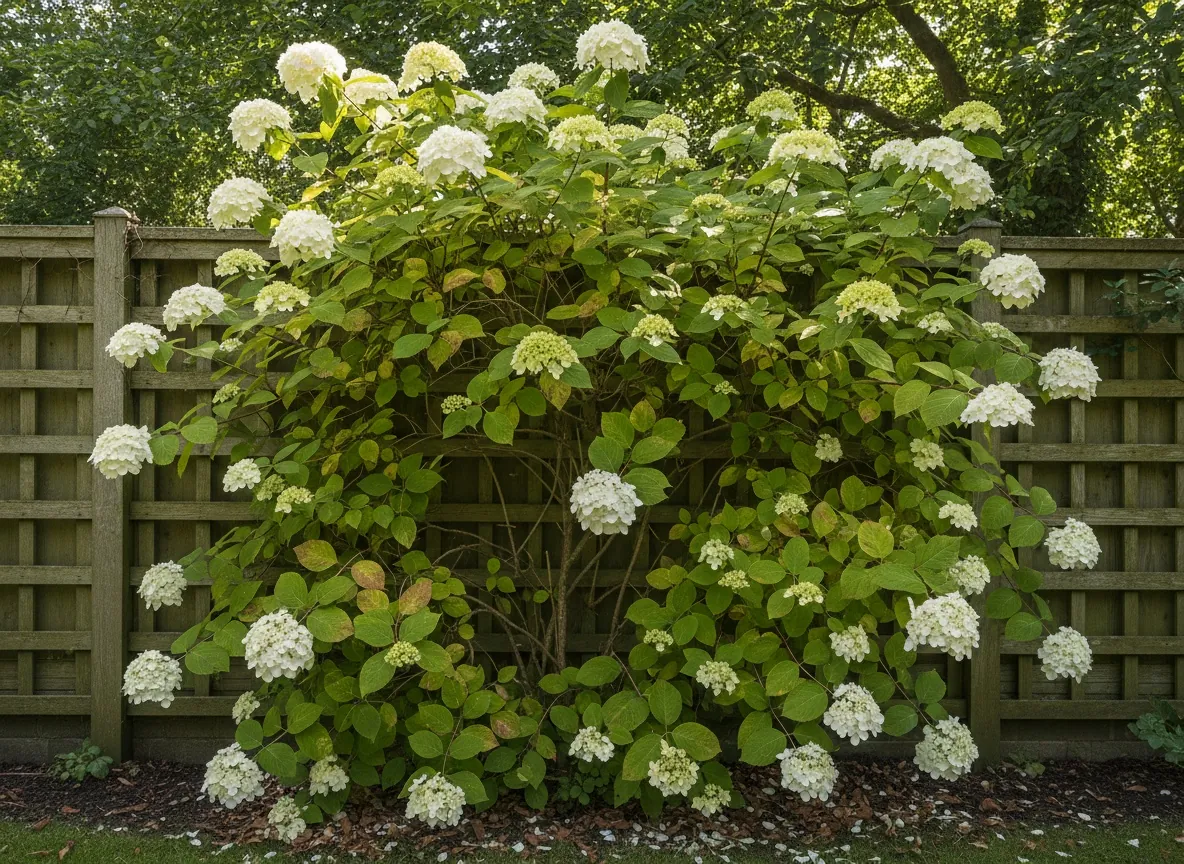
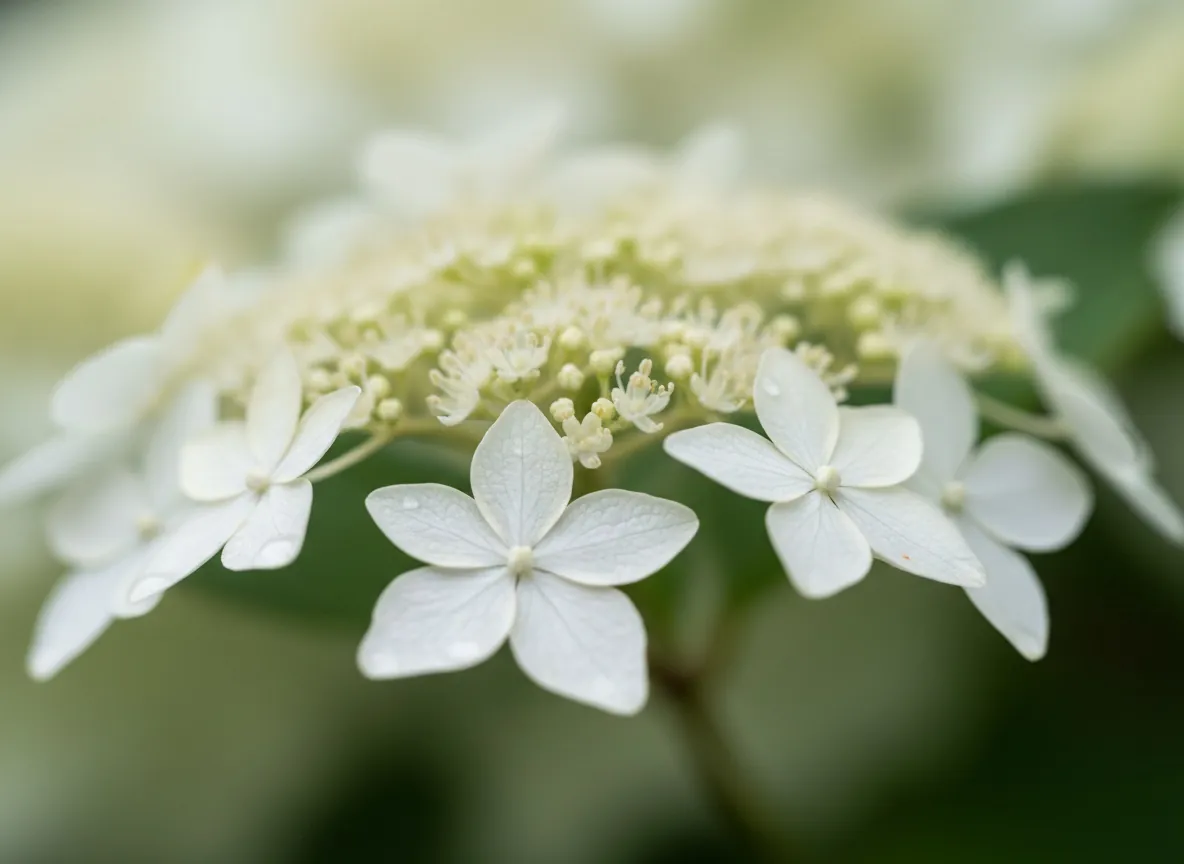
A climber reaching 6–15 m in height after some years. It attaches to its support with short aerial roots growing along the shoots, exactly like ivy. The leaves are heart-shaped, dark green, turning yellow in autumn. The inflorescences are flat lacecap corymbs: small fertile flowers in the centre, and a ring of large, white sterile flowers at the edge acting as a lure for insects. The older shoots are covered with decorative, peeling reddish-brown bark, attractive in winter.
Growing and care
Watering
Requires a constantly slightly moist substrate, especially in the first years and under the eaves of a roof, where rain does not reach the soil. Drying out shows as browning leaf margins.
Fertilizing
Moderately — the climbing hydrangea is not greedy, and excess nitrogen delays the onset of flowering.
Planting
Enrich the planting hole with compost and acid peat. Plant 25–30 cm from the wall, tilting the plant slightly towards it, and for the first year tie the shoots to the wall until they develop their own clinging roots.
Pruning
Remove dry, damaged shoots and those growing too far from the wall. The plant copes excellently with no pruning at all, so limit yourself to correcting its spread.
Companion plants
Good companions
Idealna towarzyszka u podstawy pnącza — ma te same wymagania cienia i wilgoci, a jej liście ocieniają i chłodzą glebę nad korzeniami.
Naturalne zestawienie leśne: paproć wypełnia dół cienistej ściany, gdy hortensja zdobywa jej górną część.
Zimotrwała paproć o zbliżonych wymaganiach glebowych, zakrywa nasadę pędów przez cały sezon.
Bad companions
The birch's shallow, dense and highly absorptive root system takes away the water that the hydrangea is exceptionally sensitive to lacking.
They have exactly opposite needs — the climbing hydrangea requires shade and constant moisture, in which drought-loving plants rot.
The evidence level indicates whether the relationship is backed by research, observation, or gardening tradition.
Toxicity
| For whom | Level | Notes |
|---|---|---|
| Humans | Mild | The leaves and buds contain cyanogenic glycosides; eating larger amounts may cause nausea and abdominal pain. The plant is not edible. |
| Dogs | Moderate | Eating the leaves or flowers may cause vomiting, diarrhoea and lethargy. |
| Cats | Moderate | — |
History and origin
The species was described from plants from Japan and reached European gardens in the second half of the 19th century, in the wave of plant introductions from East Asia. It is sometimes treated as the subspecies Hydrangea anomala subsp. petiolaris, which is why nurseries use both names for the same plant.
Uses
For covering shady and north-facing building walls, walls, tall tree trunks, arbours and pergolas. It also works as an original, tall ground cover on large, shaded banks, where it trails along the ground instead of climbing.
Trivia
- Gardeners describe its rate of growth with the rule “sleep, creep, leap” — in the first year it stands still, in the second it begins to creep, and from the third it takes off with vigour.
- It is one of the very few climbers that flowers profusely on a north wall, entirely deprived of direct sun.
- The clinging roots attach to the wall so firmly that pulling the shoots off can take a piece of the plaster with them.
Frequently asked questions
Does the climbing hydrangea need a support?
No — it climbs by itself using the clinging roots growing out of its shoots, just like ivy. A support is useful only in the first year, when the young shoots have to be tied to the wall before they take hold of it themselves.
Why is my climbing hydrangea not growing or flowering?
This is usually the normal behaviour of a young plant: for the first two or three years it builds its root system and hardly puts on any growth, and one may have to wait even until the fourth or fifth year for flowers. During this time it is worth ensuring constant soil moisture and not pruning the shoots in spring, as this removes the flower buds that have been set.
Does the climbing hydrangea damage a building's facade?
On sound, intact plaster and masonry it usually does no harm, but the clinging roots penetrate every crevice and may deepen existing cracks or damage loose plaster. On insulated and cracked facades it is safer to train it on a trellis set a few centimetres away from the wall.
Sources
- Plants of the World Online (POWO)Database (GBIF, POWO…)
- RHS — Hydrangea anomala subsp. petiolarisInstitution / botanical garden
My note
A private note for this plant — saved in your browser.