In short
- Position: partial shade or shade — direct sun burns out the leaf pattern.
- Substrate constantly slightly moist; it tolerates neither drying out nor waterlogging.
- Water exclusively with soft water: rain, filtered or distilled.
- It requires high air humidity — in a dry home the leaf margins turn brown.
- Completely non-toxic — safe for cats, dogs and children.
Botanical data
- Family
- Marantaceae (Marantaceae)
- Height
- 0.5–1 m
- Width
- 0.4–0.8 m
- Habit
- Clump-forming
- Growth rate
- Moderate
- Position
- Partial shade, Shade
- Soil
- Humus-rich, Peaty
- pH reaction
- pH 5.5–6.5
- Moisture
- Moist
- Bloom
- —
- Hardiness
- —
- Propagation
- By division
Characteristics
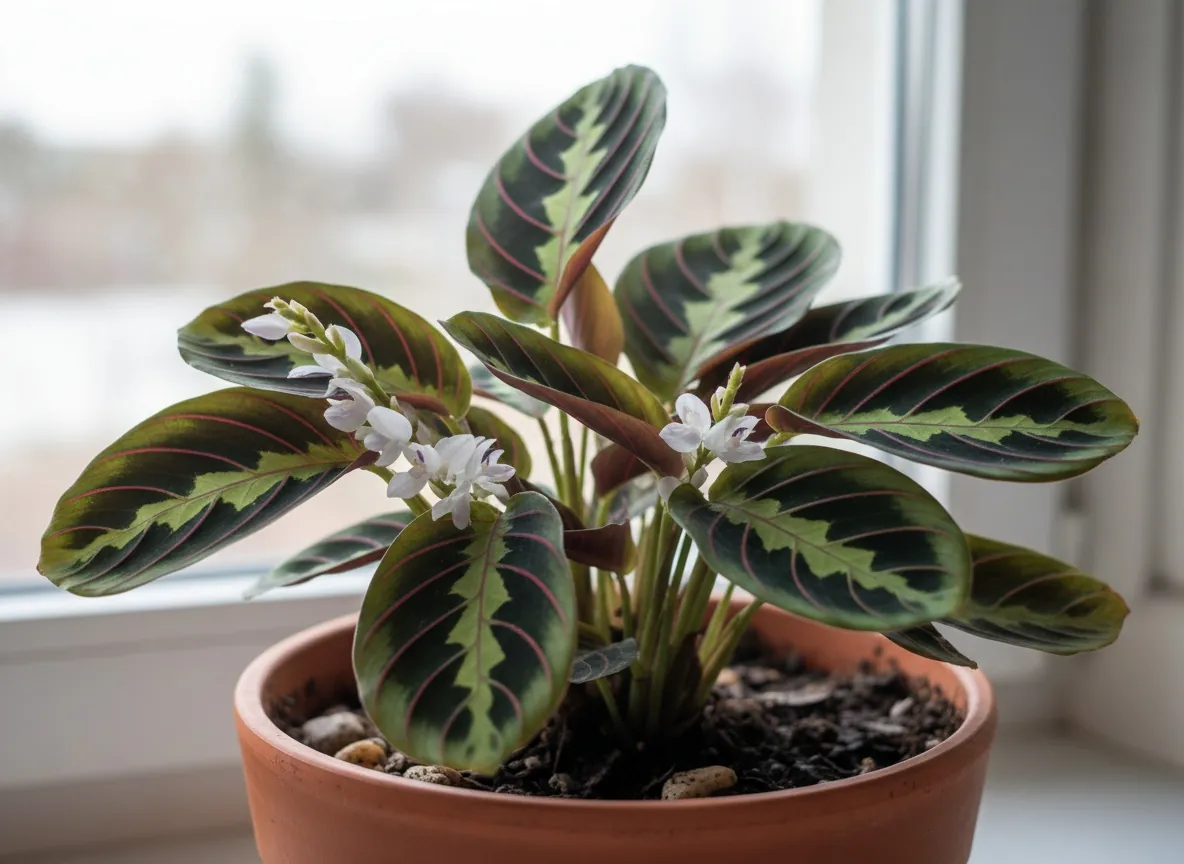
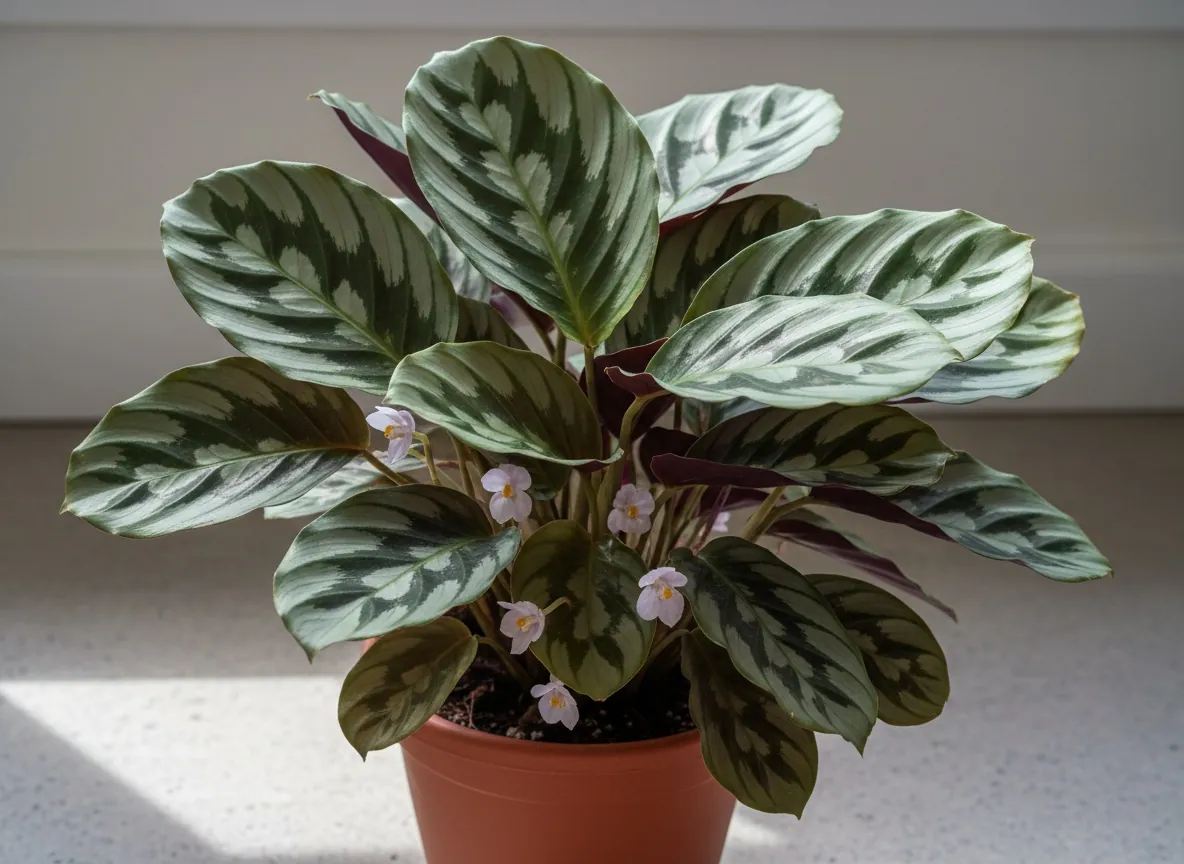
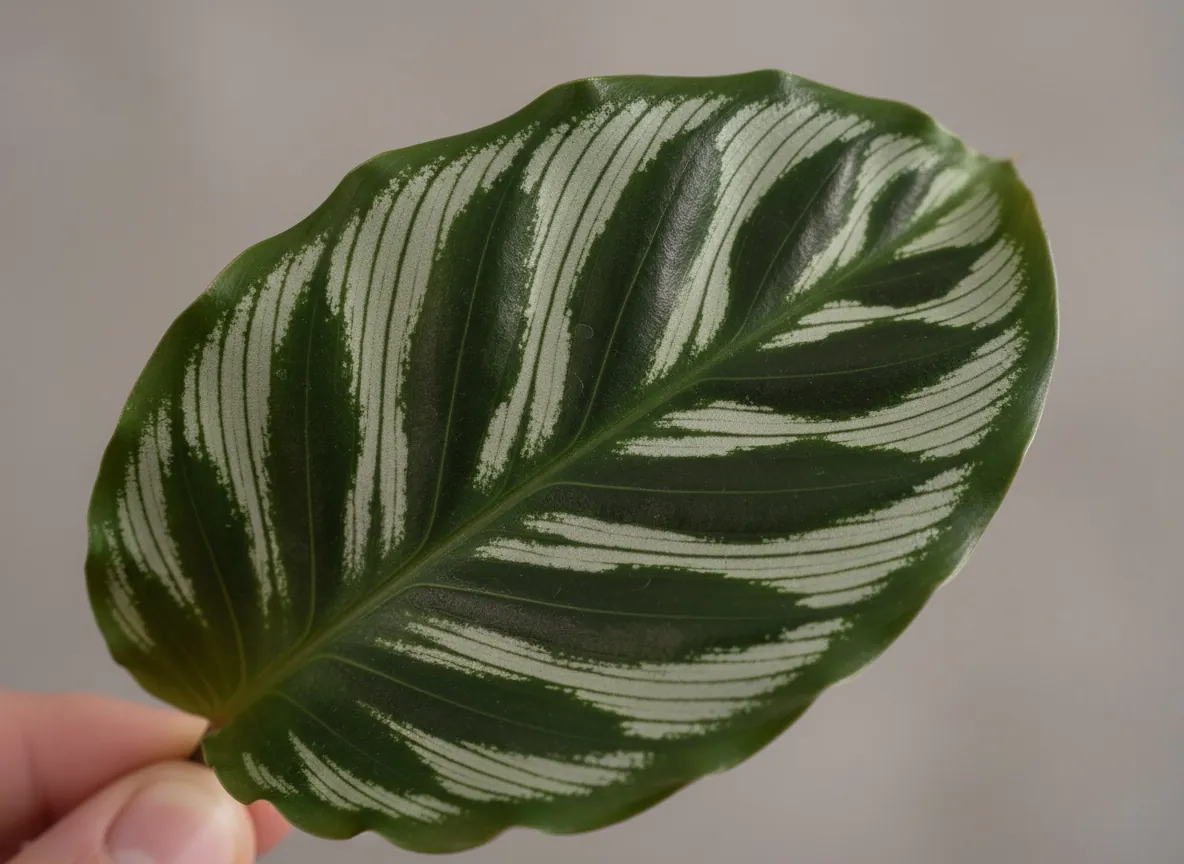
A clump-forming perennial with leaves growing directly from the rhizome on long stalks. The blades are large (20–40 cm), broadly elliptic and covered with a short velvety down, which makes them look matt. Light green, herringbone stripes run off the midrib against a dark green background; the underside of the leaf is purple. The flowers are inconspicuous, white and violet, and appear rarely indoors.
Growing and care
Watering
The substrate must be constantly slightly moist — the calathea forgives neither drying out nor waterlogging. Exceptionally sensitive to calcium, chlorine and fluoride: water exclusively with rain, filtered or distilled water at room temperature.
Fertilizing
Clearly diluted, about a quarter of the manufacturer's dose — the calathea has delicate roots and is easily salinated, which shows as browning leaf margins. Do not fertilise in winter.
Planting
A light, acidic peat substrate with added perlite and bark, retaining moisture but well drained. The pot not too large, with drainage; it can be stood on a tray of moist expanded clay to raise the air humidity.
Pruning
Cut out dried and browned leaves right at the base of the stalk. The plant needs no formative pruning — it renews itself by putting out new leaves from the centre of the clump.
Companion plants
Good companions
The fern needs the same constant moisture and partial shade, and placed together the plants mutually raise the air humidity around themselves.
Identical requirements: diffused light, moist substrate and humid air — the classic pair for a bathroom with a window.
The closest relative from the same family, with the same needs and the same nocturnal raising of the leaves — a natural combination in a single arrangement.
Bad companions
Full sun and a dry root ball mean lightning-fast drying of the leaf margins and loss of the pattern for the calathea.
The yucca requires a bright position and long breaks between waterings — conditions opposite to the calathea's needs.
The evidence level indicates whether the relationship is backed by research, observation, or gardening tradition.
Toxicity
| For whom | Level | Notes |
|---|---|---|
| Humans | None | A non-toxic plant — it does not contain the calcium oxalates typical of the arum family. |
| Dogs | None | Regarded as safe; eating the leaves does not cause poisoning. |
| Cats | None | Safe for cats — alongside the spider plant, one of the more frequently recommended plants for a home with animals. |
History and origin
The species was described from Brazil in the 19th century as Calathea zebrina and is sold under that name to this day. Molecular research from 2012, however, showed that the former genus Calathea is not uniform, and most cultivated species — including the zebra plant — were transferred to the genus Goeppertia. The trade name “calathea” has nevertheless remained in common use.
Uses
For living rooms with diffused light, away from south-facing windows and radiators. It does best in a bathroom or kitchen, where the air humidity is naturally higher, or in the company of other plants forming a shared humid microclimate. Because of its lack of toxicity it is safe in a home with a cat.
Trivia
- Calatheas are among the prayer plants: in the evening they raise their leaves to the vertical, and in the morning they lower them to the horizontal. The movement is driven by the pulvinus — a thickening at the base of the leaf stalk which changes the turgor of the cells on one side.
- The nocturnal raising of the leaves is sometimes so pronounced that a rustling can be heard in a quiet room — hence the English name of the whole group: prayer plants.
Frequently asked questions
Why does the calathea have brown, dry leaf margins?
This is the most common problem of this species and usually has two causes: air that is too dry, and watering with hard tap water, to whose calcium, chlorine and fluoride the calathea reacts exceptionally badly. You have to switch to rain, filtered or distilled water and raise the humidity — stand the pot on a tray of moist expanded clay or in a group of other plants.
Why are the calathea's leaves curling?
Leaves rolled into tubes are a signal of a dried-out root ball or air that is too dry — the plant limits evaporation in this way. After watering with soft water they usually straighten out within a day. It is worth remembering that a slight raising of the leaves at night is natural and has nothing to do with the problem.
Is the calathea safe for cats?
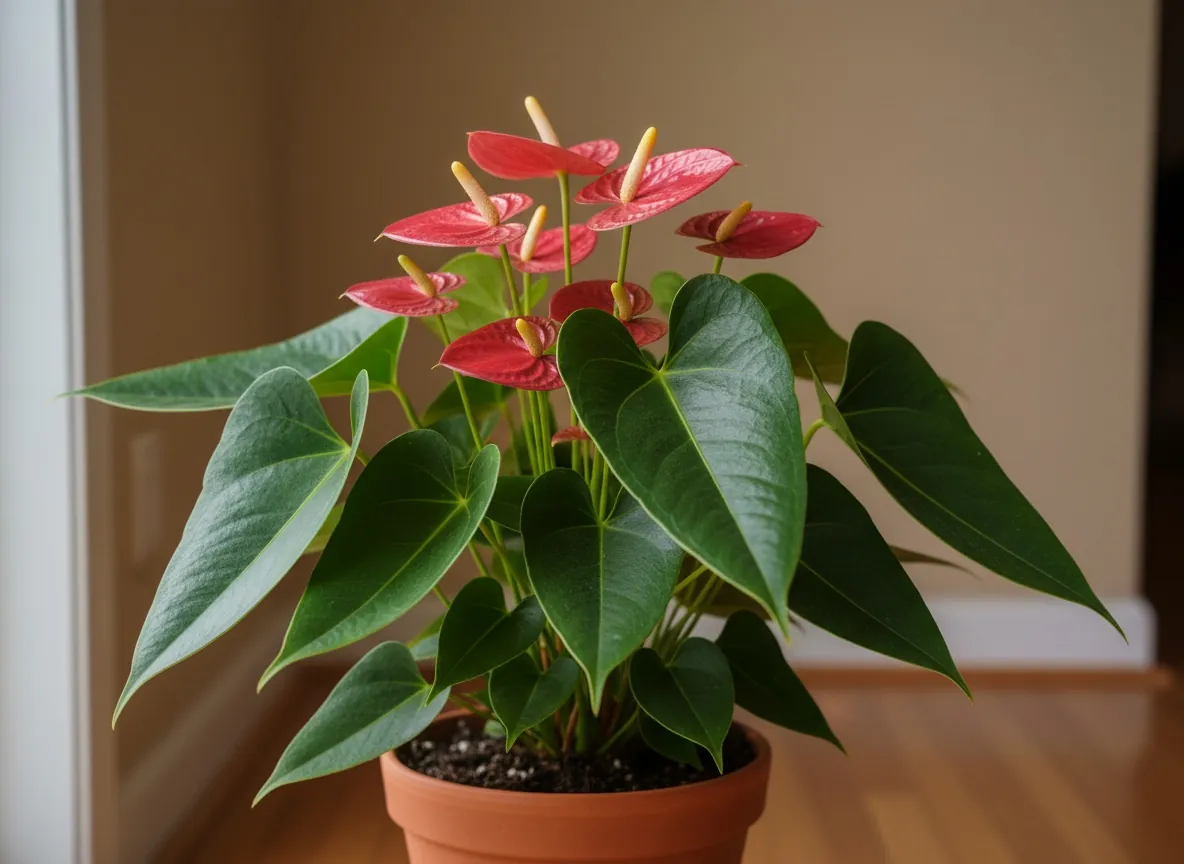
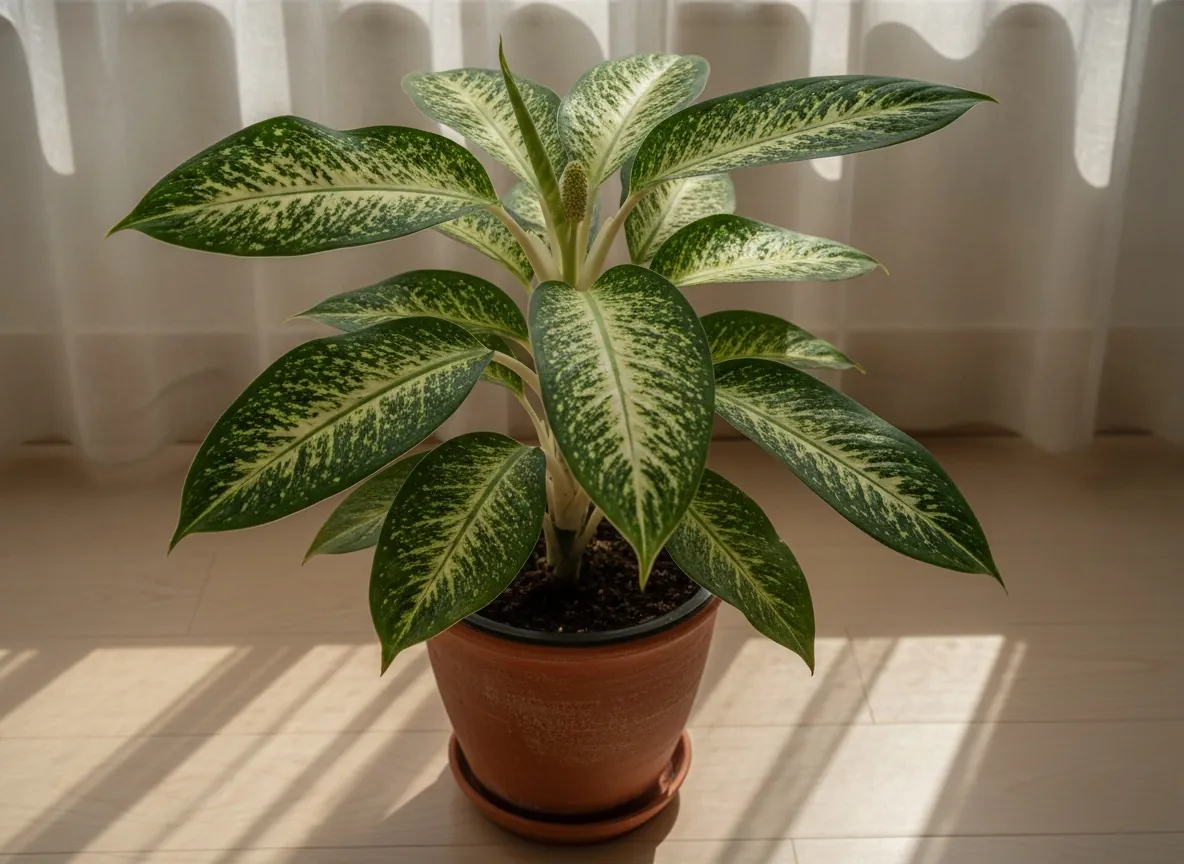
Yes. The calathea is among the plants non-toxic to cats, dogs and people — it contains neither the calcium oxalates nor the irritating sap that make dumb cane or anthurium dangerous. It is one of the few striking foliage plants that can be kept in a home with animals without concern.
Sources
- Plants of the World Online (POWO)Database (GBIF, POWO…)
- RHS — Goeppertia zebrinaInstitution / botanical garden
My note
A private note for this plant — saved in your browser.