In short
- Very strongly nectar-rich: the flat corymbs are accessible even to insects with short mouthparts.
- Flowers for a long time, from June to September; cutting back after the first flowering gives a second wave.
- Extremely tough — it withstands drought, frost down to zone 3, poor soil and mowing.
- Expansive: it spreads by runners and seeds itself abundantly, so it needs boundaries or plenty of room.
- The Polish name “krwawnik” comes from the traditional use of the herb to staunch bleeding from wounds.
- Coloured cultivars (yellow, brick, red) fade with age and need dividing every 2–3 years.
Botanical data
- Family
- Asteraceae (Asteraceae)
- Height
- 0.3–0.7 m
- Width
- 0.3–0.6 m
- Habit
- Upright
- Growth rate
- Fast
- Position
- Full sun
- Soil
- Sandy, Loamy, Chalky
- pH reaction
- pH 6–8
- Moisture
- Dry, Moderate
- Bloom
- June–September
- Hardiness
- USDA 3a–9a
- Propagation
- By division, From seed, By runners
Characteristics
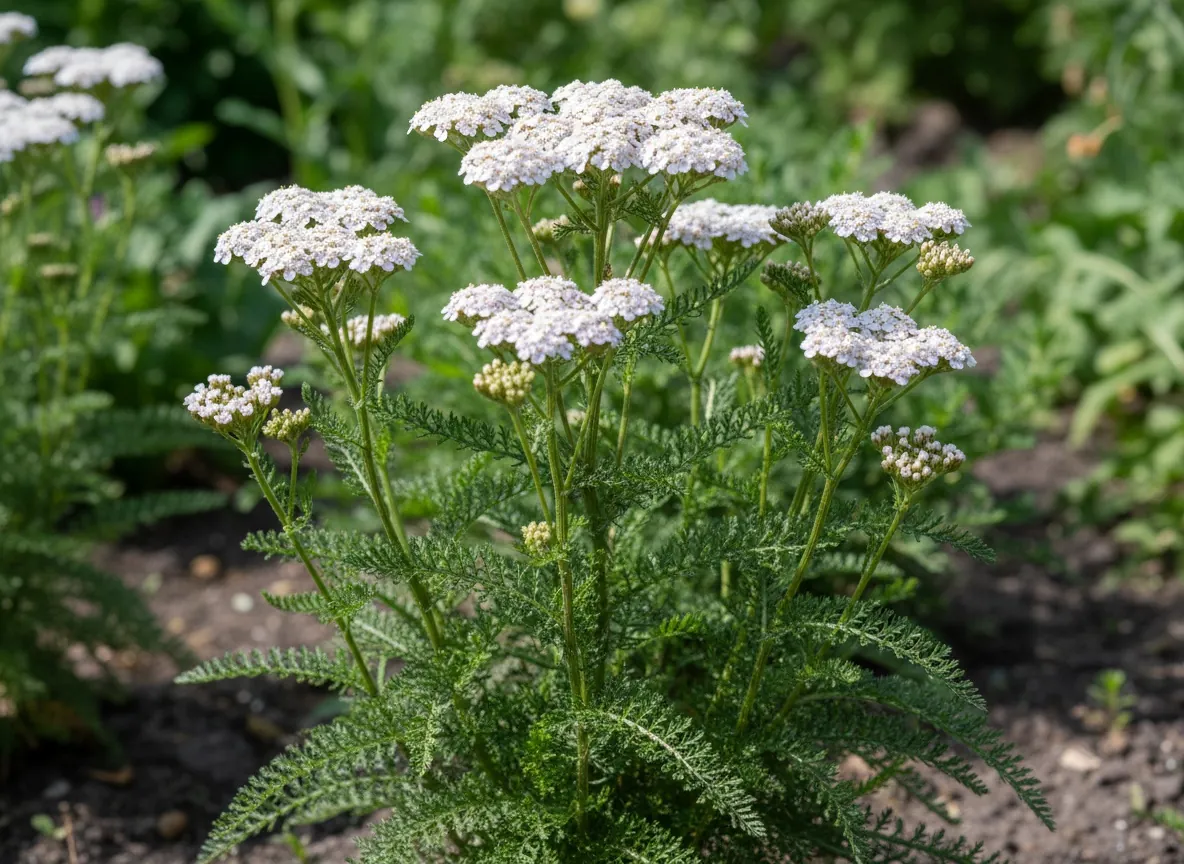
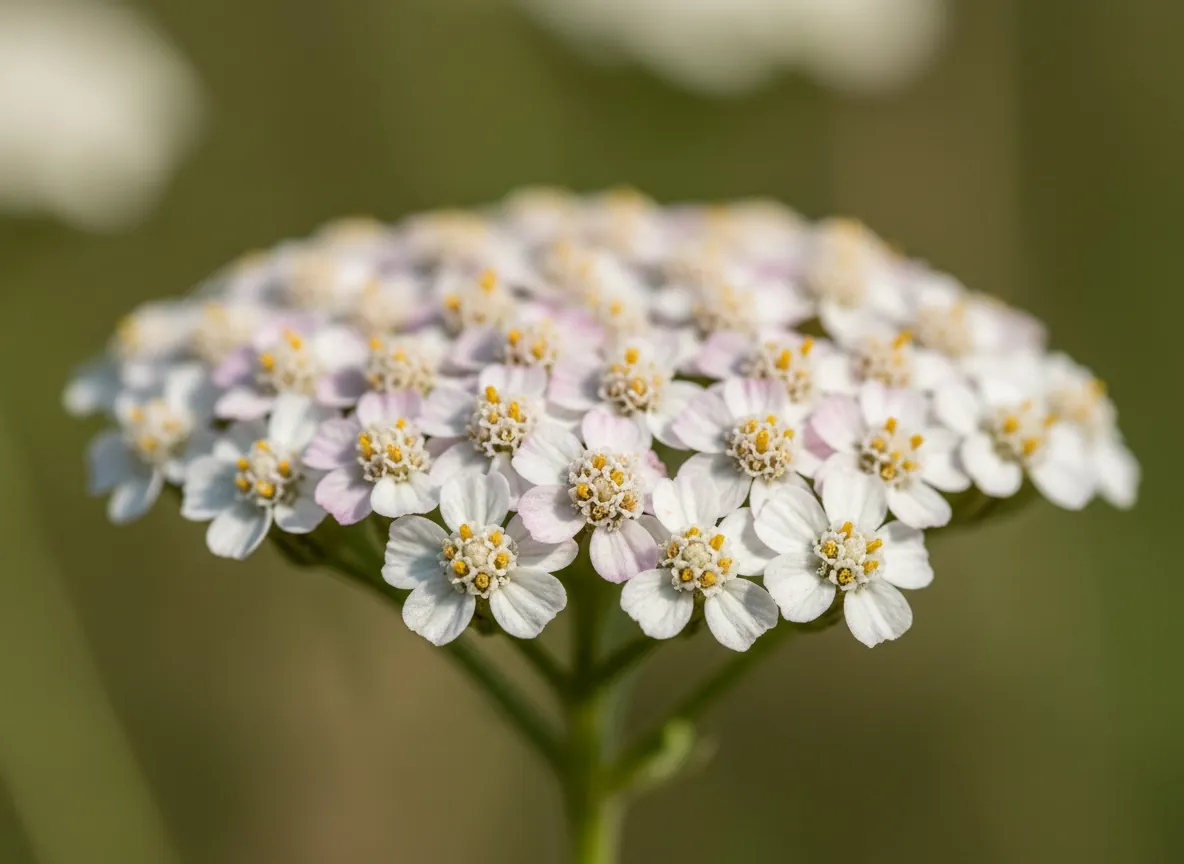
An erect perennial 30–70 cm tall, growing from creeping runners, thanks to which it forms extensive patches over time. The leaves are very characteristic: oblong, twice or three times pinnately divided into hundreds of tiny segments, which makes them look softly hairy and feathery — hence the species name millefolium, “thousand-leaved”. Crushed, they smell intensely and spicily. The small flower heads, each made up of several white ray florets and cream disc florets, are gathered several dozen at a time into dense, flat corymbs. In the wild species the flowers are white, more rarely pinkish; garden cultivars and hybrids also flower yellow, apricot, brick red and carmine.
Growing and care
Watering
It needs practically no watering — this is a plant of dry grassland and field margins. Watered and fertilised it grows lushly, but the shoots become soft and flop over after the first rain.
Fertilizing
As a rule, do not fertilise. On fertile soil fed with nitrogen, yarrow grows rank and spreads sideways — it is a plant that does better on a modest diet.
Planting
It needs no preparation — it will establish on poor and stony soil. In a fertile bed it is worth adding gravel and remembering that it will move into its surroundings by runners, so you reserve it plenty of room or confine it with edging.
Pruning
Cutting the spent corymbs just above the leaves usually brings on a second, September flowering and prevents mass self-seeding. Coloured cultivars are worth dividing every 2–3 years — otherwise the clump falls apart, weakens and loses colour intensity.
Companion plants
Good companions
Identical requirements — full sun, dry, well-drained and rather alkaline soil. A classic duo for a dry, sunny bed and the flower meadow.
A prairie combination with a coinciding flowering period and the same needs; both species are a magnet for pollinators and together they extend the nectar supply through the whole summer.
Yarrow at the edge of the vegetable garden attracts hoverflies, ladybirds and small parasitic wasps that control aphids — its flat corymbs are accessible to insects with short mouthparts, unlike the deep flowers of many perennials.
Bad companions
Conflicting requirements: yarrow needs full sun and dry soil, and with constant watering it grows rank and flops over.
Yarrow spreads by runners and quickly encroaches on its neighbours — the slow-growing alumroot with its small clump will be smothered by it.
The evidence level indicates whether the relationship is backed by research, observation, or gardening tradition.
Toxicity
| For whom | Level | Notes |
|---|---|---|
| Humans | Mild | The herb is used in herbal medicine, but it contains thujone and sesquiterpene lactones. In sensitive people, especially those allergic to the daisy family, contact with the sap causes contact dermatitis and photosensitivity. It is not recommended for pregnant women. |
| Dogs | Mild | Eating a larger quantity can cause vomiting, diarrhoea and skin irritation. |
| Cats | Mild | Symptoms as in dogs — vomiting, drooling, sometimes skin irritation. |
| Horses | Mild | Eaten in large quantities from pasture it is sometimes poorly tolerated; in normal amounts in meadow sward it poses no problem. |
History and origin
The genus name Achillea refers to Achilles, who according to Homer's account is said to have dressed the wounds of his soldiers at Troy with the herb — hence also the later Latin name herba militaris and the Polish “żołnierskie ziele” (soldier's herb). The Polish name “krwawnik” says the same thing: for centuries the herb was applied to wounds to staunch bleeding. The plant appeared in practically every European herbal, and its herb (Millefolii herba) is still a pharmacopoeial raw material today, used traditionally for digestive complaints and externally on minor cuts. At the same time yarrow was a ritual and divinatory plant in many cultures — from the British Isles to China.
Uses
For flower meadows, naturalistic and prairie beds, on dry slopes and margins, and at the edge of the vegetable garden, where it draws in beneficial insects. Coloured cultivars look good in the company of ornamental grasses and perennials with vertical flower spikes. The flowers are excellent for drying — they keep their shape and colour. Because of its expansiveness it is better not to let it in among delicate, slow-growing perennials.
Trivia
- For divination with the Chinese Book of Changes (I Ching), 50 yarrow stalks are traditionally used — the same plant that in Europe staunched the blood of Achilles' soldiers served in China for asking questions about the future.
- The flat, “plate-like” corymbs of yarrow are one of the most accessible canteens in the garden: not only bees and butterflies land on them, but also hoverflies, ladybirds, lacewings and small parasitic wasps that cannot reach the nectar in deep flowers.
- Yarrow tolerates mowing and regularly grows in lawns — in England it is sometimes deliberately added to mixtures for drought-tolerant lawns, because thanks to its deep roots it stays green when the grass has long turned brown.
Frequently asked questions
Is yarrow expansive and how do you keep it in check?
Yes, and in two ways at once: it spreads by underground runners and seeds itself abundantly. In a bed it is worth confining it with dug-in edging, and cutting off the spent flower heads before they set seed. Garden cultivars are usually calmer than the wild species, but they too spread sideways over time. Regular division every 2–3 years simultaneously limits the spread and rejuvenates the clump.
Why are my yarrows flopping over?
Almost always because of conditions that are too good. Yarrow is a plant of dry, poor grassland — in a fertile, fertilised and regularly watered bed it puts out long, soft shoots that lie down after the first rain. The solution is counter-intuitive: stop fertilising and watering, and move the plants to a drier, more fully sunlit place. Cutting back after the first flowering also helps — the regrowth is shorter and stiffer.
Is yarrow safe for children and animals?
Yarrow is not a strongly poisonous plant — it has been used as a herb for centuries. It does, however, contain thujone and sesquiterpene lactones, so eating a larger quantity can cause vomiting and diarrhoea in a dog or cat, and in people allergic to the daisy family, contact with the sap causes a rash and skin sensitivity to sunlight. The herb is not recommended for pregnant women. In practice it is a safe plant in the garden, but not entirely inert.
Sources
- Plants of the World Online (POWO) — Achillea millefoliumDatabase (GBIF, POWO…)
- Missouri Botanical Garden — Plant Finder: Achillea millefoliumInstitution / botanical garden
My note
A private note for this plant — saved in your browser.